A couple of questions for the color gurus on this board:
I have an old mare with Turn-To and Bold Ruler blood who has a very unusual black marking on her shoulder that resembles an oil slick. It's on her papers, so she's always had it. I think it might be similar to a bloody shoulder marking, except it's dark hair on a chestnut coat. The marking runs from her withers all the way down to her foreleg. She has no other markings except for a small white star on her forehead. Her sire was Turn-to Success.
Is this something that shows up occasionally in thoroughbreds or does it sound like a very rare occurance? She's registered as an appendix QH, so the marking could possibly come from her QH side.
I'm also curious about the grulla or grullo coat color in TBs. I've seen TBs that have dun factor, so it seems the grulla color is possible, but has anyone ever seen a grulla TB?
Laurie
Color/marking questions
Moderators: Roguelet, hpkingjr, WaveMaster
Color/marking questions
So many pedigrees...so little time. (C)
-
xfactor fan
- Breeder's Cup Winner
- Posts: 2212
- Joined: Thu Sep 16, 2004 8:46 pm
Zialand,
To answer the second question first, are you sure that the horse you saw as a dun, and not a buckskin? There is a lot of confusion over these two colors, but it is sorting out so that most folks call a Bay with one Cream gene a Buckskin, and a bay with a Dun gene a Dun.
The TB gene pool has the cream gene, so has buckskins, (bay + Cream) palominos (chestnut + cream) , cremellos (double cream +chestnut) and perlinos (double cream + bay).
I've never seen a Dun TB. These would be yellowish horses with a dark stripe down their back that extends up the neck, and have faint zebra striped legs. Guello would be Dun + black.
If you've seen a TB like this I'd love to see a photo.
The spots may be Bend Or spots. These are dark spots that are most common on chestnut horses. The spots can be dark red, dark brown or black, and vary from few to many.
You might want to see how many times your mare traces back to Bend Or.
To answer the second question first, are you sure that the horse you saw as a dun, and not a buckskin? There is a lot of confusion over these two colors, but it is sorting out so that most folks call a Bay with one Cream gene a Buckskin, and a bay with a Dun gene a Dun.
The TB gene pool has the cream gene, so has buckskins, (bay + Cream) palominos (chestnut + cream) , cremellos (double cream +chestnut) and perlinos (double cream + bay).
I've never seen a Dun TB. These would be yellowish horses with a dark stripe down their back that extends up the neck, and have faint zebra striped legs. Guello would be Dun + black.
If you've seen a TB like this I'd love to see a photo.
The spots may be Bend Or spots. These are dark spots that are most common on chestnut horses. The spots can be dark red, dark brown or black, and vary from few to many.
You might want to see how many times your mare traces back to Bend Or.
OK, now I'm confused. My understanding has always been that duns, buckskins and grullas were all from the same "color family" and have Dun Factor. That's why the American Buckskin Registry allows all three colors types into its registry. Buckskins, at least those I've seen of QH and QH stock blood, have dorsal stripes and sometimes sport shoulder stripes and zebra stripes on the legs (i.e. they have Dun Factor). So is the color classified as "buckskin" in a TB not the same genetic buckskin as a QH?
Thanks for helping educate me on the genetics behind different color types. When I first started reading this board, I was confused why there seemed to be so much hype about color. Now I'm beginning to understand that there may be certain genetic traits that are passed along with color types. I'm also totally fascinated with the AJC registered paint Thoroughbreds. This was news to me. I guess I was brainwashed by decades of living by a QH standard that said any white (or underlying pink skin) above the knee, hock and past the eye meant no registration papers (with AQHA at least). I guess things are even changing in that breed now as far as allowing registry of those individuals formerly classified as "paints".
Thanks for helping educate me on the genetics behind different color types. When I first started reading this board, I was confused why there seemed to be so much hype about color. Now I'm beginning to understand that there may be certain genetic traits that are passed along with color types. I'm also totally fascinated with the AJC registered paint Thoroughbreds. This was news to me. I guess I was brainwashed by decades of living by a QH standard that said any white (or underlying pink skin) above the knee, hock and past the eye meant no registration papers (with AQHA at least). I guess things are even changing in that breed now as far as allowing registry of those individuals formerly classified as "paints".
So many pedigrees...so little time. (C)
-
chiggins6
- Allowance Winner
- Posts: 363
- Joined: Fri Sep 17, 2004 7:00 am
- Location: Woods Hole, Cape Cod, MA
I'm interested, too, ZiaLand - I thought Dun was Dun the world over - and well may be, I'll have to re-read these posts. However, it may well be that "buckskin" isn't necessarily "dun" with the same gene LOL! how bout it color folks? Can you compare Buckskin and Dun for us, gene-wise, AND how do these nomenclatures translate accross breeds?
Cheryl
Cheryl
Where am I going and why am I in this handbasket!
-
xfactor fan
- Breeder's Cup Winner
- Posts: 2212
- Joined: Thu Sep 16, 2004 8:46 pm
There are currently 4 different genes that dilute dark coat color to a light or yellowish hue. Sort of like dried grass, which may be why this dilution factor has shown up so often.
Cream-This gives non-lineback colors. And works on the base coat like an incomplete dominant. One copy of the cream gene dilutes Chestnut to Palomino, Bay to Buckskin, Black to black. Two copies dilutes chestnut to cremello, Bay to perlino, black to smokey black.
This one is know to be in the TB gene pool.
Dun-This give lineback, and zebra marked legs. Just to confuse things, sometimes there is a dorsal stripe, and light to no leg markings. This works like a normal dominant. Dilutes pigment to redish yellow, and brownish yellow. Black is diluted to a pewter gray -Guello.
This probably is not present in the TB gene pool.
Champaign dilutes base colors much the same way that the Cream genes do, and Champaign on chestnut look much like Palomino. These horses are often born with green or blue eyes, and mature with light eyes, and a sort of pumpkin skin.
This probably is not present in the TB gene pool.
Barlink, or Barline (I keep forgetting which one it is) is a newly discovered recessive dilute gene, two copies dilute chestnut to palomino.
Also not present in TB's Or at least not known to be present in the TB gene pool.
Where it gets complicated, is that depending on the breed, the same color expressed by the same sets of genes can be called different names.
And some horses can carry both the Dun gene, and the cream dilute. I think these are currently being called dunalino.
Genetics is a young science and there is still a whole lot out there left to discover.
The major color gene in TB's is the Cream. Quarter horses have cream, dun and champaign, and paints have cream, dun, barlink( or barline) and maybe champaign.
As for colors having certain traits, maybe, sort of.
What is true is that the Dun gene (for example) can serve as a marker for the other genes on that chromosome. So if that chromosome carries information about bone formation, or how the gut functions, or any of a huge number of other traits, you can look at the horse, see the color and make some educated guesses about what is under the skin.
So if you have observed that in this family of horses, the duns have some trait that you like, and the non-dun horses don't, color can be used as a selection factor.
Cream-This gives non-lineback colors. And works on the base coat like an incomplete dominant. One copy of the cream gene dilutes Chestnut to Palomino, Bay to Buckskin, Black to black. Two copies dilutes chestnut to cremello, Bay to perlino, black to smokey black.
This one is know to be in the TB gene pool.
Dun-This give lineback, and zebra marked legs. Just to confuse things, sometimes there is a dorsal stripe, and light to no leg markings. This works like a normal dominant. Dilutes pigment to redish yellow, and brownish yellow. Black is diluted to a pewter gray -Guello.
This probably is not present in the TB gene pool.
Champaign dilutes base colors much the same way that the Cream genes do, and Champaign on chestnut look much like Palomino. These horses are often born with green or blue eyes, and mature with light eyes, and a sort of pumpkin skin.
This probably is not present in the TB gene pool.
Barlink, or Barline (I keep forgetting which one it is) is a newly discovered recessive dilute gene, two copies dilute chestnut to palomino.
Also not present in TB's Or at least not known to be present in the TB gene pool.
Where it gets complicated, is that depending on the breed, the same color expressed by the same sets of genes can be called different names.
And some horses can carry both the Dun gene, and the cream dilute. I think these are currently being called dunalino.
Genetics is a young science and there is still a whole lot out there left to discover.
The major color gene in TB's is the Cream. Quarter horses have cream, dun and champaign, and paints have cream, dun, barlink( or barline) and maybe champaign.
As for colors having certain traits, maybe, sort of.
What is true is that the Dun gene (for example) can serve as a marker for the other genes on that chromosome. So if that chromosome carries information about bone formation, or how the gut functions, or any of a huge number of other traits, you can look at the horse, see the color and make some educated guesses about what is under the skin.
So if you have observed that in this family of horses, the duns have some trait that you like, and the non-dun horses don't, color can be used as a selection factor.
-
easterstar
- Newborn
- Posts: 6
- Joined: Thu Sep 16, 2004 4:06 pm
ok, my browser keeps crashing on me before I can post...lets see if I can make it this time. LOL
Since xfactorfan did a good job of explaining the difference, I'll just post a link so that you can go look at pictures and see the difference.
http://members.aol.com/battyatty/buckdun.htm - this explains the difference, and also has links to pages showing various dun and cream colors.
The buckskin registry is confusing, as the name says buckskins, but they also register duns. However, its only recently that the difference between them has become widespread. It was only in like the past five years that the AQHA removed the line that said that buckskins and palominos couldn't have dorsal stripes, which had caused some horses to be registered incorrectly. While other colors can have dorsal stripes, there is a big difference between that dorsal stripe and the one seen on duns. Duns have vivid stripes, while other colors may appear to have a stripe due to countershading. My three horses all have a bit of a countershading stripe - they're bays.
And xfactorfan - the new gene is being refered to as "barlink" as it is seen in the Barlink Macho Man lines. From what I've read, there seems to be something similar happening in other breeds, like Lusitanos.
Since xfactorfan did a good job of explaining the difference, I'll just post a link so that you can go look at pictures and see the difference.
http://members.aol.com/battyatty/buckdun.htm - this explains the difference, and also has links to pages showing various dun and cream colors.
The buckskin registry is confusing, as the name says buckskins, but they also register duns. However, its only recently that the difference between them has become widespread. It was only in like the past five years that the AQHA removed the line that said that buckskins and palominos couldn't have dorsal stripes, which had caused some horses to be registered incorrectly. While other colors can have dorsal stripes, there is a big difference between that dorsal stripe and the one seen on duns. Duns have vivid stripes, while other colors may appear to have a stripe due to countershading. My three horses all have a bit of a countershading stripe - they're bays.
And xfactorfan - the new gene is being refered to as "barlink" as it is seen in the Barlink Macho Man lines.
From what I've read, there seems to be something similar happening in other breeds, like Lusitanos.-
chiggins6
- Allowance Winner
- Posts: 363
- Joined: Fri Sep 17, 2004 7:00 am
- Location: Woods Hole, Cape Cod, MA
Great, thanks X-factor, and you too, easterstar. That's a great explaination, X - I had almost sort of gotton all of that myself, but not quite so succinctly, as I have been reading up (online) about the musteno duns, Kigers, especially, found in the north west of the US which either hadn't been much bred "out"into other populations since the spanish 'originals' left here, or else had inbred enough to concentrate their 'aboriginal' genetic traits, including their coloring (dorsal stripe, zebra markings on legs, shoulders, and, interestingly, blond streaks in main and tail). As I was reading all this and caught the idea of "dun" I was alerted out of my baseline fog to wonder if it were possible to find TBs which were expressing a dun factor back to possibly their desert ancestors; not completely impossible, in theory, I would think, given the selective inbreeding found in some TB lines, if indeed inbreeding is the explaination for that Kiger-type dun factor. Just a stray thought...
Where am I going and why am I in this handbasket!
-
chiggins6
- Allowance Winner
- Posts: 363
- Joined: Fri Sep 17, 2004 7:00 am
- Location: Woods Hole, Cape Cod, MA
Oh, Easterstar, I had a beautiful palomino QH with a nice little pumpkin colored dorsal stripe. He had no white markings, and his winter coat and fetlock feathers were blonder than his summer, but there is was, a lovely dorsal stripe, with his blond mane and tail. I presume this was just pure palomino...
Where am I going and why am I in this handbasket!
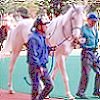
The stallion Naevus, who continues to stand in Texas and stay in the upper rankings at the 'gentle' age of 24 does have an unusual mark on his belly - but in his case it is a large irregular white patch, not a dark patch. Hence his name - but it is a bit of trick as naevus or naevy are body markings typified by concentrations or patches of melaninistic cells in the skin, hence dark - similar or the same as moles in humans. He is dual registered as a Paint and as a Thoroughbred and was so registered in the early stages of interest in breeding colorful thoroughbreds. Many of his daughters figure prominently among the pedigrees of the "white" or more technically "maximally expressed sabino" thoroughbreds.
-
xfactor fan
- Breeder's Cup Winner
- Posts: 2212
- Joined: Thu Sep 16, 2004 8:46 pm
Is there any way to tell Bend Or spots from birthmarks like naevus or nevus? Underlying skin coloration or something? Apparently Bend Or spots can be scattered through the coat, or lots in one location.
As for the Barlink horses, thanks for the info on the Lusitanos, and for the name verification. For some reason, Barlink just doesn't stick in the noggin.
If the Barlink gene is in paint horses, and Lusitanos, it is most likely in other Spanish derived breeds like quarter horses.
Wonder if it might be one of the genes involved in Isabellas--the very lightest shade of palomino?
No wonder early Palomino breeders were baffled. Three different genes all giving "yellow" horses. Yikes!
As for the Barlink horses, thanks for the info on the Lusitanos, and for the name verification. For some reason, Barlink just doesn't stick in the noggin.
If the Barlink gene is in paint horses, and Lusitanos, it is most likely in other Spanish derived breeds like quarter horses.
Wonder if it might be one of the genes involved in Isabellas--the very lightest shade of palomino?
No wonder early Palomino breeders were baffled. Three different genes all giving "yellow" horses. Yikes!

Interesting. I have a mare who has a medium sized dark spot on her... she's a chestnut with four whites and a blaze, as well as the white chin. Her weanling filly is also chestnut with four whites and a blaze, and she has a small dark spot in the white of each hind leg, down by the coronet.
Someone mentioned melanistic cells in reference to the dark spots... does anyone know if it's been shown that there are any links between these color markings and a horse's succeptability to cancerous cells? The mare I described above has a sarcoid on her neck, and now I'm wondering if there may be any connections there.
Thoughts on that???
Someone mentioned melanistic cells in reference to the dark spots... does anyone know if it's been shown that there are any links between these color markings and a horse's succeptability to cancerous cells? The mare I described above has a sarcoid on her neck, and now I'm wondering if there may be any connections there.
Thoughts on that???
-
Sandi in Florida
- Maiden Special Weight
- Posts: 168
- Joined: Thu Sep 16, 2004 4:13 pm
- Location: Florida
Rogulet--are these ermine spots on your filly? If so, that would be something entirely different than melanistic cells. Ermine spots show up on lots of TBs--I always think they're so cool. Here's this stately TB, mostly solid, with maybe a small white sock or two, and if you look closer, the sock has POLKA DOTS--isn't that a riot? I thought they happened mostly on bays, but perhaps they can happen on a chestnut too. At any rate, if this is indeed what your filly has, she's one stylish little sistah! Takes a lot of guts to wear polka dotted socks!
you give, you get
love and protect
and good will always follow you
--Yellowman
love and protect
and good will always follow you
--Yellowman