Ormond By The Sea, a ch 2003 Cape Canaveral x Eloping gelding, has the same set of spots all over his right shoulder as have been noted on Gunning For, Hosco, and Silver Whistle.
If this is some skin condition, which I suspect it is, maybe we could keep track of where these cases crop up. Ormond By The Sea is at Keeneland.
Check out the fine pictures by HoosierShadow:
http://www.finalturngallery.com/album1240/race_3_2_Ormond_By_The_Sea_with_Jesus_Castanon
http://www.finalturngallery.com/album1240/race_3_1_Tidy_Up_1A_Joint_Session_and_2_Ormond_By_The_Sea
Another one with weirdo spots on shoulder
Moderators: Roguelet, hpkingjr, WaveMaster
Make that two. Also at Keeneland, racing on the same day, is Fort Prado.
http://www.finalturngallery.com/album1240/race_8_7_Fort_Prado_the_winner_and_2_Esprit_Du_Roi
http://www.finalturngallery.com/album1240/race_8_7_Fort_Prado_the_winner3
http://www.finalturngallery.com/album1240/race_8_7_Fort_Prado_the_winner_and_2_Esprit_Du_Roi
http://www.finalturngallery.com/album1240/race_8_7_Fort_Prado_the_winner3
-
summerhorse

- Breeder's Cup Winner
- Posts: 2178
- Joined: Wed Oct 26, 2005 6:40 am
- Location: Panama City, FL
- Contact:
Birdcatcher spots
Birdcatcher spots is indeed what Ormond by the Sea has. The term came from the stallion (I think) Birdcatcher who was apparently the first well known horse to exhibit them (I'm sure not the first TB though, just the first of note) and thus they became known as Birdcatcher spots just as Bend Or spots (dark spots on a chest, bay or brown coat) were named after Bend Or who was the first "famous" horse to have them but certainly not the first TB to have them. Birdcatcher spots can come and go and change size over the horse's life. There are other spots found (so far mostly in TB, Arab and ASB) in other breeds that look the same but don't change, they are born that way and stay that way, they tend to have more though that cover more of the body (Pelouse's Queen). They COULD be birdcacher spots but they seem not to be because they don't change.
These are unrelated to Appaloosa snowflake spotting.
Lord Prado has something different going on. You'd have to see his baby picture to know if he had a white spot or not (he could be a sabino, that picture is just showing up too dark on here and the angle is not good to see his markings). If he had a white spot that could simply be white skin underneath the grey coat showing through because he's all wet and in a short coat (versus winter fuzzy). Or that could be an unusually large chubari patch (those splotches that steel greys often have which also vary greatly in size, color and come and go, like The Tetrarch) which caused the skin to lose pigment too or he could have vitiligo. But most horses like that have had a patch of white when they were dark.
These are unrelated to Appaloosa snowflake spotting.
Lord Prado has something different going on. You'd have to see his baby picture to know if he had a white spot or not (he could be a sabino, that picture is just showing up too dark on here and the angle is not good to see his markings). If he had a white spot that could simply be white skin underneath the grey coat showing through because he's all wet and in a short coat (versus winter fuzzy). Or that could be an unusually large chubari patch (those splotches that steel greys often have which also vary greatly in size, color and come and go, like The Tetrarch) which caused the skin to lose pigment too or he could have vitiligo. But most horses like that have had a patch of white when they were dark.
Every mighty oak was once an acorn that stood its ground.
I respectfully disagree. I have documented several recent cases of otherwise solid-colored horses developing these white patches in adulthood, often on their shoulders. It's too early to tell in all cases, but they seem to go away. The timing and location suggests that these are most certainly not birdcatcher spots, but a product of some environmental factor.
I'm too lazy to put together all the pictures I have, but you can look up Hosco, Ormond By The Sea, Smuggler, Fort Prado, Gunning For, and Silver Whistle (?). In my opinion, these are clearly something other than Birdcatcher spots.
In fact, I would also hesitate to call whatever Pelouse's Queen has 'Birdcatcher spots.' I put her into a special category of 'just plain weird' along with Will Spy Now and Not I
In fact, I would also hesitate to call whatever Pelouse's Queen has 'Birdcatcher spots.' I put her into a special category of 'just plain weird' along with Will Spy Now and Not I
-
xfactor fan
- Breeder's Cup Winner
- Posts: 2212
- Joined: Thu Sep 16, 2004 8:46 pm
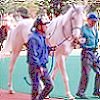

Jorge - Mighty Valdiar by Mighty Forum x Some Kind of Soul by Dixieland Brass. So, can YOU tell me where the spots came from?  He always had some white hairs interspersed throughout his coat, but the spots just came in this fall. His full sister has a lot of white hairs in her coat too, but she's still only 2, so will see what she looks like come next fall. Kristie
He always had some white hairs interspersed throughout his coat, but the spots just came in this fall. His full sister has a lot of white hairs in her coat too, but she's still only 2, so will see what she looks like come next fall. KristieKristie, I knew a grey arabian that was pure white and had chestnut colored spots all over him. They looked like brown measles. These were referred to as" flea bites" and he was called a "flea bitten grey". Was a handsome horse but his coat coloring was strange because you would have expected the spots to be black, like most greys are.
-
summerhorse
- Breeder's Cup Winner
- Posts: 2178
- Joined: Wed Oct 26, 2005 6:40 am
- Location: Panama City, FL
- Contact:
fungus amungus?
It could be a fungus, they do exist but that is treatable (albeit with a low success rate). But birdcatcher spots can show up at ANY stage of life, they can stay the same or they can disappear and reappear over time. They vary in size and density but most are smallish (versus the chubari splotches in greys or large patches of white due to sabino). They may turn out to be related to some sabino modifier but we don't know anything about their inheritance right now.
Every mighty oak was once an acorn that stood its ground.