Did Patelin ('68) produce any registered black foals?
Moderators: Roguelet, hpkingjr, WaveMaster
-
Sunday Silence
- Moderator
- Posts: 649
- Joined: Thu Sep 16, 2004 12:14 pm
Did Patelin ('68) produce any registered black foals?
Patelin is registered black filly so I took a look at her offspring on this site, but none of the foals are black, but then again not all of the foals have a color listed for them.
Last edited by Sunday Silence on Fri Mar 31, 2006 1:34 pm, edited 1 time in total.
-
summerhorse

- Breeder's Cup Winner
- Posts: 2178
- Joined: Wed Oct 26, 2005 6:40 am
- Location: Panama City, FL
- Contact:
How many foals does he have and are there are lot of dark bay or browns listed? (If there are probably a few are black) But if he was bred to a bunch of mares who were AA he'd have no blacks, bred to Aa he'd only have 50% chance of blacks BEFORE you factor in the Ee or ee. But if he doesn't have a lot of foals then you can't tell much from that anyway esp. if they don't list all the colors.
Every mighty oak was once an acorn that stood its ground.
-
Sunday Silence
- Moderator
- Posts: 649
- Joined: Thu Sep 16, 2004 12:14 pm
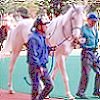
Apropos PATELIN, I was browsing her data and discovered something worth mentioning and worth of clarification.
According to the Del Mar Pedigree Database PATELIN (blk M 1968) produced from the cover of KEY TO THE MINT (bay H 1969) the mare, KEY PRINCESS (1976), who appears here as a "gray". Immediately a warning light came on for everybody knows that genuine "grays" only appears via at least one "gray" immediate parent ----which is not case here. I thought that perhaps we were dealing with another "Negruzca" case. [[1]]
But then I checked KEY PRINCESS' progeny and to my amazement I discovered another anomaly. That is, that in 1989 she produced from the cover of SPICY STORY (bay H 1981) a "gray" filly named SPICY KEY. As a mare, SPICY KEY has not produced any other "gray" (OF COURSE!).
Can anyone shed more light on the reality here?
Blessings,
[[1]] "Neguzca" (her name means "blackish in Spanish) was an extraordinary PR-bred champion mare who represented Puerto Rico internationally in the Clasico del Caribe. She was by Scandal (very dark in color), out of Welthia (gray), by All Hands out of Daphne Dear (gray). Her color was completely charcoal black and stayed that way up to her late brilliant sophomore season. But there was something suspicious about her. The very lower-end tip of her tail was gray, but very minimal. But she always was and remained registered as "dark bay or brown", almost blackish in color. Reason for her name. But later as a 4-year-old, her coat grayed out and she ended up becoming a normal gray. Actually she was a gray, but a very late developing one.
According to the Del Mar Pedigree Database PATELIN (blk M 1968) produced from the cover of KEY TO THE MINT (bay H 1969) the mare, KEY PRINCESS (1976), who appears here as a "gray". Immediately a warning light came on for everybody knows that genuine "grays" only appears via at least one "gray" immediate parent ----which is not case here. I thought that perhaps we were dealing with another "Negruzca" case. [[1]]
But then I checked KEY PRINCESS' progeny and to my amazement I discovered another anomaly. That is, that in 1989 she produced from the cover of SPICY STORY (bay H 1981) a "gray" filly named SPICY KEY. As a mare, SPICY KEY has not produced any other "gray" (OF COURSE!).
Can anyone shed more light on the reality here?
Blessings,
[[1]] "Neguzca" (her name means "blackish in Spanish) was an extraordinary PR-bred champion mare who represented Puerto Rico internationally in the Clasico del Caribe. She was by Scandal (very dark in color), out of Welthia (gray), by All Hands out of Daphne Dear (gray). Her color was completely charcoal black and stayed that way up to her late brilliant sophomore season. But there was something suspicious about her. The very lower-end tip of her tail was gray, but very minimal. But she always was and remained registered as "dark bay or brown", almost blackish in color. Reason for her name. But later as a 4-year-old, her coat grayed out and she ended up becoming a normal gray. Actually she was a gray, but a very late developing one.
Jorge wrote:Apropos PATELIN, I was browsing her data and discovered something worth mentioning and worth of clarification.
According to the Del Mar Pedigree Database PATELIN (blk M 1968) produced from the cover of KEY TO THE MINT (bay H 1969) the mare, KEY PRINCESS (1976), who appears here as a "gray". Immediately a warning light came on for everybody knows that genuine "grays" only appears via at least one "gray" immediate parent ----which is not case here. I thought that perhaps we were dealing with another "Negruzca" case. [[1]]
But then I checked KEY PRINCESS' progeny and to my amazement I discovered another anomaly. That is, that in 1989 she produced from the cover of SPICY STORY (bay H 1981) a "gray" filly named SPICY KEY. As a mare, SPICY KEY has not produced any other "gray" (OF COURSE!).
Can anyone shed more light on the reality here?
Blessings,
May I ask what defines a Genuine Grey? I could have sworn a grey horse was a grey horse-God knows I have plenty of them-does their value go up if they are a GENUINE grey?
[[1]] "Neguzca" (her name means "blackish in Spanish) was an extraordinary PR-bred champion mare who represented Puerto Rico internationally in the Clasico del Caribe. She was by Scandal (very dark in color), out of Welthia (gray), by All Hands out of Daphne Dear (gray). Her color was completely charcoal black and stayed that way up to her late brilliant sophomore season. But there was something suspicious about her. The very lower-end tip of her tail was gray, but very minimal. But she always was and remained registered as "dark bay or brown", almost blackish in color. Reason for her name. But later as a 4-year-old, her coat grayed out and she ended up becoming a normal gray. Actually she was a gray, but a very late developing one.
If you check the progeny report at this site:
http://www.tbhorsepedigree.com/progeny_ ... tby=dobASC
you will see the correct progeny record and colors.
http://www.tbhorsepedigree.com/progeny_ ... tby=dobASC
you will see the correct progeny record and colors.
PlaytoWin wrote:Jorge wrote:Apropos PATELIN, I was browsing her data and discovered something worth mentioning and worth of clarification.
According to the Del Mar Pedigree Database PATELIN (blk M 1968) produced from the cover of KEY TO THE MINT (bay H 1969) the mare, KEY PRINCESS (1976), who appears here as a "gray". Immediately a warning light came on for everybody knows that genuine "grays" only appears via at least one "gray" immediate parent ----which is not case here. I thought that perhaps we were dealing with another "Negruzca" case. [[1]]
But then I checked KEY PRINCESS' progeny and to my amazement I discovered another anomaly. That is, that in 1989 she produced from the cover of SPICY STORY (bay H 1981) a "gray" filly named SPICY KEY. As a mare, SPICY KEY has not produced any other "gray" (OF COURSE!).
Can anyone shed more light on the reality here?
Blessings,
May I ask what defines a Genuine Grey? I could have sworn a grey horse was a grey horse-God knows I have plenty of them-does their value go up if they are a GENUINE grey?
[[1]] "Neguzca" (her name means "blackish in Spanish) was an extraordinary PR-bred champion mare who represented Puerto Rico internationally in the Clasico del Caribe. She was by Scandal (very dark in color), out of Welthia (gray), by All Hands out of Daphne Dear (gray). Her color was completely charcoal black and stayed that way up to her late brilliant sophomore season. But there was something suspicious about her. The very lower-end tip of her tail was gray, but very minimal. But she always was and remained registered as "dark bay or brown", almost blackish in color. Reason for her name. But later as a 4-year-old, her coat grayed out and she ended up becoming a normal gray. Actually she was a gray, but a very late developing one.
There are some horses who are carriers of the sabino and or rabicano gene who have enough white hairs in their coats that they appear to be roan or going gray. They aren't true grays because they don't have a gray parent. Jorge has a great interest in grays and horses that show the effects of the sabino(especially maxium white sabino) and rabicano genes.
Nu
-
summerhorse
- Breeder's Cup Winner
- Posts: 2178
- Joined: Wed Oct 26, 2005 6:40 am
- Location: Panama City, FL
- Contact:
So you can see from her correct progeny report there are 8 possibilities for black offspring since almost all blacks are registered dk. b or br.
As for greys that aren't these are sometimes rabicano, usually sabinos (ticked all over). Go to Painted Desert and they have two of them that without the body spotting would be registered as "grey or roan" because there is no place for "black sabino roan/ticked all over" on the papers!
Anyway Painting Freedom and Alaadin Dancer show the pattern and it isn't uncommon for these horses to have "normal" or even minimal markings. http://www.painteddesert.net/atstud.html
The difference is that these horses will never turn white like a true grey.
As for greys that aren't these are sometimes rabicano, usually sabinos (ticked all over). Go to Painted Desert and they have two of them that without the body spotting would be registered as "grey or roan" because there is no place for "black sabino roan/ticked all over" on the papers!
Anyway Painting Freedom and Alaadin Dancer show the pattern and it isn't uncommon for these horses to have "normal" or even minimal markings. http://www.painteddesert.net/atstud.html
The difference is that these horses will never turn white like a true grey.
Every mighty oak was once an acorn that stood its ground.