JC Papers and colour DNA
Moderators: Roguelet, WaveMaster, Jorge, Sunday Silence
-
Derby Lyn

- Restricted Stakes Winner
- Posts: 980
- Joined: Fri Nov 09, 2007 9:18 am
- Location: Michigan
- Contact:
She is a gorgeous filly. Love the name.
[email protected]
www.derbylynfarms.wix.com/derbylynfarms
https://www.facebook.com/#!/pages/Derby ... 2803203931
Breeder of thoroughbreds for sport.
www.derbylynfarms.wix.com/derbylynfarms
https://www.facebook.com/#!/pages/Derby ... 2803203931
Breeder of thoroughbreds for sport.
-
xfactor fan
- Breeder's Cup Winner
- Posts: 2212
- Joined: Thu Sep 16, 2004 8:46 pm
Let's start with the grey color.
Grey is dominant, and will over right any other coat color. Horses can carry one copy of the gene in which case 50% of the offspring will be grey. Two copies all offspring will be 100%.
What's going on with the dark bay/brown horses is more complicated.
Horses of this color can be:
Dark Bay --Agouti Gene (Bay--A)
Dark Brown No-Agouti (No bay--aa)
Black No Agouti (No Bay --aa)
Or Black (No Agouti aa plus Cream Cr.)
Take a look at Donna's Smoky Black mare.
Without testing which most TB owners don't care about, hard to tell exactly which genotype (the actual genes the horse has) is expressing which phenotype (what the horse looks like)
I don't know that anyone has done a lot of work on the genetics of shades.
One gene that is talked about is Sooty, which adds black hair to the coat.
There's one genetic testing service that is offering testing for Brown (at)
Given that there have been a couple of rather prolific stallions that were brown Bold Ruler comes to mind, it should be a surprise that the frequency of the brown gene is rather high in the TB.
You might try looking at the horses in question and see how many have Bold Ruler, War Admiral, or Seattle Slew close up in the family tree.
Hope this helps.
Grey is dominant, and will over right any other coat color. Horses can carry one copy of the gene in which case 50% of the offspring will be grey. Two copies all offspring will be 100%.
What's going on with the dark bay/brown horses is more complicated.
Horses of this color can be:
Dark Bay --Agouti Gene (Bay--A)
Dark Brown No-Agouti (No bay--aa)
Black No Agouti (No Bay --aa)
Or Black (No Agouti aa plus Cream Cr.)
Take a look at Donna's Smoky Black mare.
Without testing which most TB owners don't care about, hard to tell exactly which genotype (the actual genes the horse has) is expressing which phenotype (what the horse looks like)
I don't know that anyone has done a lot of work on the genetics of shades.
One gene that is talked about is Sooty, which adds black hair to the coat.
There's one genetic testing service that is offering testing for Brown (at)
Given that there have been a couple of rather prolific stallions that were brown Bold Ruler comes to mind, it should be a surprise that the frequency of the brown gene is rather high in the TB.
You might try looking at the horses in question and see how many have Bold Ruler, War Admiral, or Seattle Slew close up in the family tree.
Hope this helps.

-
xfactor fan
- Breeder's Cup Winner
- Posts: 2212
- Joined: Thu Sep 16, 2004 8:46 pm
To comment on accphotography
[quote]Well it's been proven that black bases actually SUPPRESS white... well, sabino white. DW could be different. Black certainly doesn't suppress splash. But I just wanted to say that I've seen HORDES of red based LOUD or entirely white DWs. *shrugs*[/quote]
Base coat is EE, or Ee (black) or ee (red) extension. Bay or Agouti is located on a different chromsome and only affects black base coat animals. So a red based horse could carry the black (a) version of the gene without expressing it. As could a bay.
So a red based DW horse could be ee (red)
aa (black) but not expressed
DW full expression.
The whole DW gene is quite interesting ( or at least I find it so) If you go back an look at the historical record there has been a debate if the gene actually exists or not, or if it is a homozygous lethal. Some writers even suggest that the breeders of white horse can't tell the difference between a pure white horse and a double dilute. Or even a gray gone white with age.
The range of expression of the DW gene has such a wide range, from what Jorge call stained white to full white. The only common factor I've been able to see in looking into the pedigrees, is that the full expression horses seem to have a black ancestor close up in the family tree, and may be carrying the recessive version of Agouti (a)
Just want to restate: I don't think it is exactly the Agouti (a) gene, but something that lives near (a), close enough that (a) can be used as a marker.
I'd love to hear from anyone with a full expression DW who had done the testing. Would be interesting to find out if this theory has any merit.
[quote]Well it's been proven that black bases actually SUPPRESS white... well, sabino white. DW could be different. Black certainly doesn't suppress splash. But I just wanted to say that I've seen HORDES of red based LOUD or entirely white DWs. *shrugs*[/quote]
Base coat is EE, or Ee (black) or ee (red) extension. Bay or Agouti is located on a different chromsome and only affects black base coat animals. So a red based horse could carry the black (a) version of the gene without expressing it. As could a bay.
So a red based DW horse could be ee (red)
aa (black) but not expressed
DW full expression.
The whole DW gene is quite interesting ( or at least I find it so) If you go back an look at the historical record there has been a debate if the gene actually exists or not, or if it is a homozygous lethal. Some writers even suggest that the breeders of white horse can't tell the difference between a pure white horse and a double dilute. Or even a gray gone white with age.
The range of expression of the DW gene has such a wide range, from what Jorge call stained white to full white. The only common factor I've been able to see in looking into the pedigrees, is that the full expression horses seem to have a black ancestor close up in the family tree, and may be carrying the recessive version of Agouti (a)
Just want to restate: I don't think it is exactly the Agouti (a) gene, but something that lives near (a), close enough that (a) can be used as a marker.
I'd love to hear from anyone with a full expression DW who had done the testing. Would be interesting to find out if this theory has any merit.
-
BlazingColours
- Allowance Winner
- Posts: 486
- Joined: Thu Feb 28, 2008 3:20 pm
- Location: Southern Ontario
- Contact:
I have tested a few of mine. Will have to go dig up the results.
And to the original poster... yes waiting for the DNA kit is normal. However I did get the one for my Feb foal right away though all live foals were reported at the same time. So I wonder if they do jan/feb first hten march/april etc...
You guy does look quite white. Congrats on selling him. I have had good results selling my *white* foals as well.
And to the original poster... yes waiting for the DNA kit is normal. However I did get the one for my Feb foal right away though all live foals were reported at the same time. So I wonder if they do jan/feb first hten march/april etc...
You guy does look quite white. Congrats on selling him. I have had good results selling my *white* foals as well.
Last edited by BlazingColours on Tue Jun 29, 2010 4:36 am, edited 1 time in total.
Living life for the journey, not the destination.
Join us on FACEBOOK
Join us on FACEBOOK
-
BlazingColours
- Allowance Winner
- Posts: 486
- Joined: Thu Feb 28, 2008 3:20 pm
- Location: Southern Ontario
- Contact:
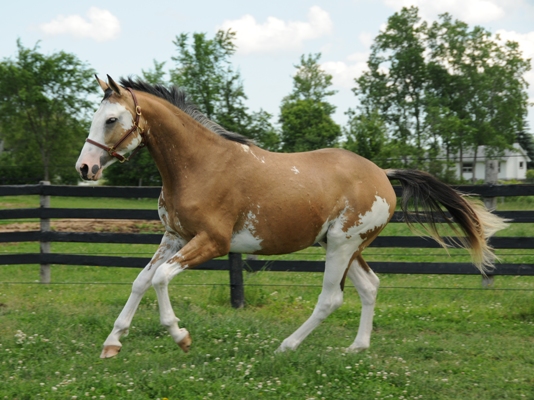
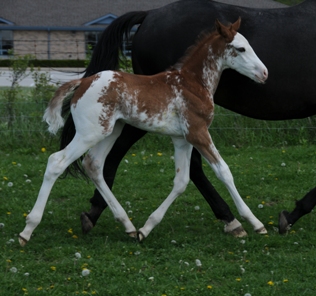
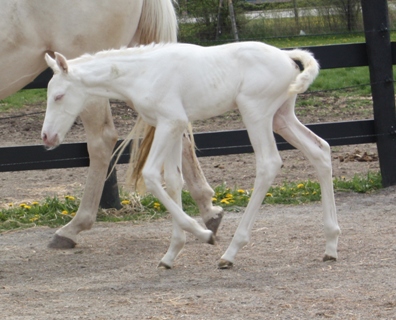
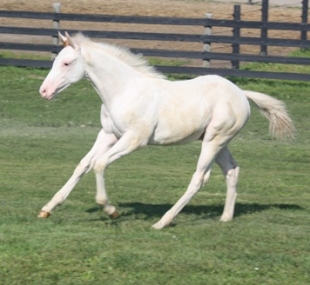
 2010 full sibling to Simba Twist. Ee AA no dilution

-
xfactor fan
- Breeder's Cup Winner
- Posts: 2212
- Joined: Thu Sep 16, 2004 8:46 pm
Thanks for posting the photos along with the DNA test results. In a sample of 5 horses, 4 fit the theory.
Love to see more results, with something as complex as genetics, 4 out of 5 is a promising start. Not perfect confirmation, and the sample is very small, so it could be chance, that the colors fell out that way.
Love to see more results, with something as complex as genetics, 4 out of 5 is a promising start. Not perfect confirmation, and the sample is very small, so it could be chance, that the colors fell out that way.
-
RiddleMeThis

- Allowance Winner
- Posts: 371
- Joined: Sun Apr 13, 2008 6:28 am
The problem with those is that the loud are RED based. And the black bases are minimal expression. Which is how it SUPPOSED to be.
If you want to compare how "a", or something near "a" effects expression, everything else has to be the same. You can't take one base color that is known to show full expression and compare it to another basecolor that is known to limit expression, and try and make "a" conclusions based on them.
Those red bases would have been loud no matter their "a" or "A" status as red bases promote white.
If you want to compare how "a", or something near "a" effects expression, everything else has to be the same. You can't take one base color that is known to show full expression and compare it to another basecolor that is known to limit expression, and try and make "a" conclusions based on them.
Those red bases would have been loud no matter their "a" or "A" status as red bases promote white.
Check out my Equine Genetics blog! Updated April 25th with Splashed White!!!
http://equinegenetics.blogspot.com/
http://equinegenetics.blogspot.com/
-
xfactor fan
- Breeder's Cup Winner
- Posts: 2212
- Joined: Thu Sep 16, 2004 8:46 pm
I've actually been looking at the expression of DW for several years, and have found a stronger correlation between Agouti status than base coat.
Take Sato for example.
Minimal expression of DW. Base coat red, Agouti status unknown, cream, possible sabino.
Sato has several genetic factors working together:
Red base coat which is know to express white more than black based horses.
DW, which can be minimal, like Sato himself, or full white.
Unknown Agouti status
Some form of sabino
We know he's got DW since he's throwing white foals.
The question is what is going on with Sato that is supressing the full white coat pattern?
My best guess is that there is some complex interaction between, base coat, Agouti, and the Sabino status on the other #3 chromosome.
And just because Sabino works one way, there is no guarantee that DW will have the same type of interaction with base coat color. It might, but then again it might not.
Which is why it was so nice to see actual data on some of the DW horses, pedigree research is nice, but real data is so much better.
Anyone else have coat color data on their DW horses?
Take Sato for example.
Minimal expression of DW. Base coat red, Agouti status unknown, cream, possible sabino.
Sato has several genetic factors working together:
Red base coat which is know to express white more than black based horses.
DW, which can be minimal, like Sato himself, or full white.
Unknown Agouti status
Some form of sabino
We know he's got DW since he's throwing white foals.
The question is what is going on with Sato that is supressing the full white coat pattern?
My best guess is that there is some complex interaction between, base coat, Agouti, and the Sabino status on the other #3 chromosome.
And just because Sabino works one way, there is no guarantee that DW will have the same type of interaction with base coat color. It might, but then again it might not.
Which is why it was so nice to see actual data on some of the DW horses, pedigree research is nice, but real data is so much better.
Anyone else have coat color data on their DW horses?
-
accphotography

- Restricted Stakes Winner
- Posts: 996
- Joined: Tue Jul 29, 2008 12:03 am


-
accphotography
- Restricted Stakes Winner
- Posts: 996
- Joined: Tue Jul 29, 2008 12:03 am
-
xfactor fan
- Breeder's Cup Winner
- Posts: 2212
- Joined: Thu Sep 16, 2004 8:46 pm
Could you clarify the terms "FWIW" ? Not familiar with this notation.
http://www.blazingcoloursfarm.com/Sato.html Pictures of Sato.
In terms of regular solid horses, he's quite marked. In terms of Dominant White, he's (to my eye, and depending on which side you look at) below 50% white.
What leads you to suspect that he's AA? Not arguing, just would like to know your logic chain.
As for genes on different chromosomes interacting, the classic example would be bay- Agouti and base coat color are on different chromosomes, and yet there is a clear interaction.
Another example based on the research from the Appaloosa group is that LP--appy roan, and the pattern are on different chromosomes. Add to this collection, gray, and cream, both modify base coat colors.
So based on these examples, it doesn't seem out of line to wonder about a mystery modifier linked to the recessive version of Agouti (a)
I've also wondered if the DW needs a strong version of Sabino on the other #3 to express as full white.
For the record, the start of this theory came from the detailed research that Jorge did on white TB's. He did a lot of research on the parents and siblings of historic white TB's and one of the odd things that turned up was the number of white TB's with black parents. This was interesting and I started looking at pedigrees when a new white TB turned up. And surprise, surprise, a lot of them could have been Aa, or aa.
Thank you Jorge for your research.
http://www.blazingcoloursfarm.com/Sato.html Pictures of Sato.
In terms of regular solid horses, he's quite marked. In terms of Dominant White, he's (to my eye, and depending on which side you look at) below 50% white.
What leads you to suspect that he's AA? Not arguing, just would like to know your logic chain.
As for genes on different chromosomes interacting, the classic example would be bay- Agouti and base coat color are on different chromosomes, and yet there is a clear interaction.
Another example based on the research from the Appaloosa group is that LP--appy roan, and the pattern are on different chromosomes. Add to this collection, gray, and cream, both modify base coat colors.
So based on these examples, it doesn't seem out of line to wonder about a mystery modifier linked to the recessive version of Agouti (a)
I've also wondered if the DW needs a strong version of Sabino on the other #3 to express as full white.
For the record, the start of this theory came from the detailed research that Jorge did on white TB's. He did a lot of research on the parents and siblings of historic white TB's and one of the odd things that turned up was the number of white TB's with black parents. This was interesting and I started looking at pedigrees when a new white TB turned up. And surprise, surprise, a lot of them could have been Aa, or aa.
Thank you Jorge for your research.
-
TrueColours

- Grade I Winner
- Posts: 1635
- Joined: Fri Sep 17, 2004 6:07 am
- Location: Ontario, Canada
- Contact:
Well - the TCF Nightlight filly (Guaranteed Gold / Puchi Trap by Puchilingui) is a/a. Havent tested her Red Factor and she is a smoky black
Guaranteed Gold is e/e and A/a
Wer havent tested the dam but she has thrown chestnut, bay and black based foals so that would make her ???
Here is a picture of Nightlight:

and:

Guaranteed Gold is e/e and A/a
Wer havent tested the dam but she has thrown chestnut, bay and black based foals so that would make her ???
Here is a picture of Nightlight:
and:
www.TrueColoursFarm.com
Breeders of unique coloured Thoroughbreds & Sport Horses - standing Guaranteed Gold - 16.1hh cremello TB stallion - CSHA and AQHA, APHA, ApHC listed
Breeders of unique coloured Thoroughbreds & Sport Horses - standing Guaranteed Gold - 16.1hh cremello TB stallion - CSHA and AQHA, APHA, ApHC listed
Puchi Trap genetics
TrueColours wrote:Wer havent tested the dam but she has thrown chestnut, bay and black based foals so that would make her ???
She's bay so she expresses E and A
She's thrown chestnut (ee) so she has to be Ee
She's thrown black (aa) so she has to be Aa
Simple, no?

-
accphotography
- Restricted Stakes Winner
- Posts: 996
- Joined: Tue Jul 29, 2008 12:03 am