English Channel is priced at $25K for 2008.
Question: I am not educated in how these new stallions are priced. If he is standing for $25K does that mean we can assume he sold for a specific price? The owners did sell him, does the fee give an indication of what the price was?
Please excuse my ignorance.
English Channel
Moderators: Roguelet, WaveMaster, madelyn
-
Morningside
- Maiden Special Weight
- Posts: 205
- Joined: Thu Oct 13, 2005 7:13 pm
- Location: New York, NY
-
Morningside
- Maiden Special Weight
- Posts: 205
- Joined: Thu Oct 13, 2005 7:13 pm
- Location: New York, NY
-
bcassidy
- Restricted Stakes Winner
- Posts: 876
- Joined: Thu Sep 16, 2004 5:36 pm
- Location: Springfield twshp, NJ
Morningside. How did you calculate the value at 7M? I would have calculated his sydication value at 3M.
My calculations look like this--- share price would be 3 times his season stud fee or 75k; times 40 shares for a total value of 3M. I know there can be lots of variations but this would be a typical deal as I know it.
How did you arrive at your syndication price? (even though there is none in this case)---I am curious what factors you used. Thanks in advance for explaining in more detail.
My calculations look like this--- share price would be 3 times his season stud fee or 75k; times 40 shares for a total value of 3M. I know there can be lots of variations but this would be a typical deal as I know it.
How did you arrive at your syndication price? (even though there is none in this case)---I am curious what factors you used. Thanks in advance for explaining in more detail.
best regards Brendan
-
Hold Your Peace
- Allowance Winner
- Posts: 495
- Joined: Fri Nov 24, 2006 7:12 am
The 'old' formula used to be 5 x stud fee = share price x 40 shares.
So 5 x 25,000 = 125,000 x 40 = $5 million
However the 'old' formula doesn't apply anymore because most farms breed almost twice as many mares as they used to.
Then there are all kinds of other variables (for example if the stallion were to shuttle), and also on the low end with stallions these formula's don't apply. Plenty of $5,000 stallions (who the 'old' formula says would be worth $1 million) were actually purchased for more like $150,000.
Anyway, you can pretty much double the old formula but then maybe knock of 20% to come up with something close to a fair valuation.
So as to a value for English Channel I think $7 million might be about right based on the stud fee. Wether there was actually enough interest in him to justify that valuation on the open market I don't know. A smallish turf horse can be a tough sell in the states.
So 5 x 25,000 = 125,000 x 40 = $5 million
However the 'old' formula doesn't apply anymore because most farms breed almost twice as many mares as they used to.
Then there are all kinds of other variables (for example if the stallion were to shuttle), and also on the low end with stallions these formula's don't apply. Plenty of $5,000 stallions (who the 'old' formula says would be worth $1 million) were actually purchased for more like $150,000.
Anyway, you can pretty much double the old formula but then maybe knock of 20% to come up with something close to a fair valuation.
So as to a value for English Channel I think $7 million might be about right based on the stud fee. Wether there was actually enough interest in him to justify that valuation on the open market I don't know. A smallish turf horse can be a tough sell in the states.

-
Morningside
- Maiden Special Weight
- Posts: 205
- Joined: Thu Oct 13, 2005 7:13 pm
- Location: New York, NY
-
bcassidy
- Restricted Stakes Winner
- Posts: 876
- Joined: Thu Sep 16, 2004 5:36 pm
- Location: Springfield twshp, NJ
Morningside, larrygene----I have purchased a few stallion shares and the ones that I am familiar with give bonus breeding seasons, non-saleable to every syndicate member, usually one per share at the beginning of a stallions breeding career. The farm usually gets 4 breeding seasons depending upon their advertising commitment and the trainer of the stallion usually gets 1-2 breeding seasons. So that would get you to about 85 seasons for a typical syndication. Any income above these seasons would be general income for the partnership and divided up amongst the share holders at the end of the year after expenses have been paid.
Do you have first hand knowledge of different syndication models or are you summizing what the value of the syndication would be based upon the number of mares bred to a stallion. The reason I am asking is----I haven't bought into a stallion in the past 3 years and I want to know if the model is changing
Do you have first hand knowledge of different syndication models or are you summizing what the value of the syndication would be based upon the number of mares bred to a stallion. The reason I am asking is----I haven't bought into a stallion in the past 3 years and I want to know if the model is changing
best regards Brendan
-
Morningside
- Maiden Special Weight
- Posts: 205
- Joined: Thu Oct 13, 2005 7:13 pm
- Location: New York, NY
hi bcassidy, basically if you're a syndicate manager bidding for a stallion, you have to come up with some sort of valuation. so you consider how many mares you can book to him at what price, and you determine your final bid price from there. so the fact that the price of a share usually follows a consistent formula, that is about a 3-year payback for the shareholder, is just a consequence of syndicate manager successfully assessing the market value for the stallion's stud fee.

-
bdw0617

- Darley line
- Posts: 9206
- Joined: Thu May 03, 2007 10:19 pm
- Location: Los Angeles, CA
- Contact:
I have two questions
first being, in this type of situtation where the owner never actually sells the horse (that's how I understand it, correct me if i'm wrong), how does the stud farm benefit?
Also, my second question is I actually love him as a stallion prosepct, do you think he is versitle enough to where his offspring would like dirt?
first being, in this type of situtation where the owner never actually sells the horse (that's how I understand it, correct me if i'm wrong), how does the stud farm benefit?
Also, my second question is I actually love him as a stallion prosepct, do you think he is versitle enough to where his offspring would like dirt?
"When the solution is simple, God is answering.”
- Einstein
- Einstein
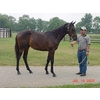
bdw,
I like his pedigree because I think he can produce versatile racehorses. I think he has a good combination of sire lines that have proven to produce both dirt and turf horses. Same with his bottom lines. But, I think it depends on the mares going to him. If a mare's family has a preponcity for dirt, then your chances of getting a good dirt horse are good.
But I wouldn't be surprised if he does get horses that are just as effective on all surfaces.
I wish I could afford to breed to him.
winds
I like his pedigree because I think he can produce versatile racehorses. I think he has a good combination of sire lines that have proven to produce both dirt and turf horses. Same with his bottom lines. But, I think it depends on the mares going to him. If a mare's family has a preponcity for dirt, then your chances of getting a good dirt horse are good.
But I wouldn't be surprised if he does get horses that are just as effective on all surfaces.
I wish I could afford to breed to him.
winds