I think the Arabian added the large heart to the modern TB. So here's the logic behind this.
I think--can't prove that the large heart gene is a complex on the equine X chromosome. This is based on research the Australians did investigating Phar Lap their own large heart TB hero.
If it was a straight autosomal gene like grey, breeders would be able to breed horses with large hearts even if they didn't know what they were doing. Super racehorse sires lots of foals that run better than other horses, they go to stud, sire more.... So pretty soon the population of horses in pretty short order has lots of large heart horses. This is based on the fact that European and American breeders mostly ignore the female lines.
The Arab horse breeders have always tracked the maternal lines--stallions were ok, but they revered the mares. If the large heart mutation happened on the equine X, it is more likely to be noticed, nurtured and bred for by breeders who track the matriarchal line of descent.
As for the mechanics of the theoretical large heart, I think there is a region on the X that controls heart size. During a cross over between the two X chromosomes, the splice in not quite right giving a chromosome that has an extra copy or two of the region controlling size. This could work both way, producing one X that produces a larger heart, and one X that would produce a smaller heart and would depend on which chromosome goes on to the egg, and in turn produces a foal. And in fact there is a range of heart sizes in TB's and in Arabians. Don't know about the Turkoman horses.
Interestingly dogs don't seem to have a range of heart sizes. And the regular size dogs--not toys--have wolf size hearts. And normal lifespans. The large breeds, Great Danes, Wolfhounds, Deerhounds, Mastiff's don't live very long. A Great Dane is old at 7 or 8. The heart can't support the extra mass of these big bodies.
I'm sure that the folks who love these large breeds would be delighted to have them around for more than 7 years, and would both notice and breed to lines that would live longer.
Ok end of hijack.
And I'm willing to discuss any part of this with anyone. And would love to hear from some other points of view.
Early patterns of the TB.
Moderators: Roguelet, hpkingjr, WaveMaster, Lucy
-
Pan Zareta

- Breeder's Cup Winner
- Posts: 2074
- Joined: Wed Dec 22, 2004 10:55 am
- Location: west TX boonies
Matchemforever wrote: Therefore, I find it interesting to find some Raise A Native lines more recently added in.
I haven't heard the same criticism of his soundness in the context of his QH descendants, but it doesn't appear that he's being inbred to as much in the QH, and the shorter distances might be 'friendlier'.
For an interesting look at a non-racing pedigree- although quite heavy in Three Bars blood, take a look at the progenitor of the HYPP malady in QH's:
http://www.allbreedpedigree.com/impressive6
One wonders if they went back to the same well a little too often and a little too close. Was it an odd chance mutation or something pushed by too much close inbreeding?
HYPP is a simple autosmomal dominant trait that originated as a random mutation in Impressive. It has nothing to do w/ his inbreeding to Three Bars.
fwiw, I've never seen a real cowboy sitting on anything that looked like Impressive.

I don't think outcrossing now as a solution is going to work.
Work as a solution to what? If the goal is to improve soundness and stamina in the TB, imho the first step would be a uniform standard 'no tolerance' policy throughout venues in the USA for racing on most 'medications' + a policy re. bleeders similar to Australia's. Then go back to carding more dirt races at true classic distance, 12f or better, and put some major purse money there (make the JCGC a 2mi race again!).
Although they probably share 99% of the same 'root stock' the racing Quarters have come from different 'branches', and allowing those that can to perform their way into the NorthAm TB registry could increase its diversity to some extent (i.e. open up some graded stakes to registered Quarters and let's see what happens).
It's disingenuous to assume that the presence of two short-pedigreed mares on Dash For Cash's sire side would have kept him from being competitive w/ the best TBs of his generation - or being an influence for stamina in the breeding shed, for that matter. His BMS was a 10f horse. His 'broodmare grandsire' and 3d BMS ran 1st & 2d in the 1941 JCGC - at 2 miles.
More blaspemy.

-
Matchemforever
- Maiden Special Weight
- Posts: 169
- Joined: Wed May 14, 2008 12:07 pm
Thanks for the correction on Three Bars.
Would the large heart gene be another random autosmomal mutation?
If the large heart might of come from the Arabs, might it also have come
from other breeds developed in that region? Might the large heart gene be
a factor in stamina, especially since they used to race 4 mile heats? Yet,
you have the Duke of Newcastle, who implies that the ability to run, even
long distances, was not the purview of the Arab or that they were more successful at it:
http://books.google.com/books?id=2aUCAA ... g=PA79&dq=
Irish+Hobbies,+horse&source=web&ots=XiSFfiUdQJ&sig=B7PNtDAluJhOYZ2G
nu1OJaX02k8&hl=en&sa=X&oi=book_result&resnum=2&ct=result#PPA80,M1
The Horse of America in His Derivation, History and Development ...
By John Hankins Wallace
“……In regard to the speed of the
horses bred for that purpose, Mr. Gervase Markham, the second Englishman who undertook to write a
book on the horse, has given us some very interesting and valuable information. He
brought out his work in the latter part of the sixteenth century, and it passed through several "enlarged
and improved" editions.
In the edition of 1606 he says: "
For swiftness what nation bas brought forth the horse which excelled the
English ? When the best Barbanes that ever were iu their prime, I saw them
overcome by a black Hobbie, of Salisbury, and yet that black Hobbie was overcome
by a horse called Valentine, which Valentine neither in hunting nor
running was ever equalled, yet was a plain English horse, both by syre and
dam."
From this we must conclude that some horses from the Barbary States had been brought over previous
to 1606, which doubtless antedated the arrival of King James' Arabian. This is the horse known as the
Markham Arabian, and is in the above list of foundation stallions. In speaking of the Arabian horses as a
breed, the Duko of Newcastle remarks as follows upon this particular representative of that breed: "
I never saw but one of these horses, which Mr. John Markham, a
merchant, brought over and said be was a right Arabian. He was a bay, but n
little horse, and no rarity for shape. for I have seen many English horses far
finer. Mr. Markham sold him to King James for five hundred pounds, and
being trained up for a course (race), when he came to run every horse beat
him."
The duke then goes on to speak of the staying qualities of the
Arabians: "
They talk they will ride fourscore miles in a day and never draw
the bridle. When I was young I could have bought a nag for ten pounds that
would have done as much very eatily."
These remarks are repeated here because they are specially pertinent
in this connection. It will be conceded by every one who has any knowledge of the
liorse history of this period that the Duke of Newcastle was the best-informed man of his generation on
all subjects connected with the history and breeding of the horse. His preference for blood was in the
following order: The Barb, the Turk, the Spaniard, the Neapolitan, and the handsomest of the English
stock. It will be observed that in this classification the Arabian has no place. From these illustrations, to
which other similar ones might be added, it seems to be evident that the native English stock did
not lack speed so much as they lacked quality, finish, and beauty.
So, could the Irish Hobbies have carried the large heart gene as well?
I am fascinated by the idea that the Arab may be over rated as the originator of the TB. Not trying in any way to put them down, but what has been taken for granted for years may simply be incorrect or only a small piece of the puzzle that was the creation of the TB. Horses that came from anywhere in the region of the middle east might have been labeled Arab without that necessarily being the case.
Of course, that gets back into the probable common ancestry of the Barb, Turk, and Arab, and what exactly differentiates the breeds and where the branch off occured.
Back to off topic a bit:
Dash for Cash had more than one problem in his pedigree, besides a TB ancestor with incomplete records. (La Galla Win) Lightfoot Sis, Go Man Go's dam, pretty much a documented mix of TB and Quarter Horses.
However, for fun, take a look at Rocket Wrangler.
http://www.allbreedpedigree.com/rocket+wrangler
Does he look just a smidge like Northern Dancer? Ooops, more blasphemy...
FYI, I am limited by the accuracy of TB and All Breed pedigree query. I don't have a lot of other access to pedigrees other than those.
Would the large heart gene be another random autosmomal mutation?
If the large heart might of come from the Arabs, might it also have come
from other breeds developed in that region? Might the large heart gene be
a factor in stamina, especially since they used to race 4 mile heats? Yet,
you have the Duke of Newcastle, who implies that the ability to run, even
long distances, was not the purview of the Arab or that they were more successful at it:
http://books.google.com/books?id=2aUCAA ... g=PA79&dq=
Irish+Hobbies,+horse&source=web&ots=XiSFfiUdQJ&sig=B7PNtDAluJhOYZ2G
nu1OJaX02k8&hl=en&sa=X&oi=book_result&resnum=2&ct=result#PPA80,M1
The Horse of America in His Derivation, History and Development ...
By John Hankins Wallace
“……In regard to the speed of the
horses bred for that purpose, Mr. Gervase Markham, the second Englishman who undertook to write a
book on the horse, has given us some very interesting and valuable information. He
brought out his work in the latter part of the sixteenth century, and it passed through several "enlarged
and improved" editions.
In the edition of 1606 he says: "
For swiftness what nation bas brought forth the horse which excelled the
English ? When the best Barbanes that ever were iu their prime, I saw them
overcome by a black Hobbie, of Salisbury, and yet that black Hobbie was overcome
by a horse called Valentine, which Valentine neither in hunting nor
running was ever equalled, yet was a plain English horse, both by syre and
dam."
From this we must conclude that some horses from the Barbary States had been brought over previous
to 1606, which doubtless antedated the arrival of King James' Arabian. This is the horse known as the
Markham Arabian, and is in the above list of foundation stallions. In speaking of the Arabian horses as a
breed, the Duko of Newcastle remarks as follows upon this particular representative of that breed: "
I never saw but one of these horses, which Mr. John Markham, a
merchant, brought over and said be was a right Arabian. He was a bay, but n
little horse, and no rarity for shape. for I have seen many English horses far
finer. Mr. Markham sold him to King James for five hundred pounds, and
being trained up for a course (race), when he came to run every horse beat
him."
The duke then goes on to speak of the staying qualities of the
Arabians: "
They talk they will ride fourscore miles in a day and never draw
the bridle. When I was young I could have bought a nag for ten pounds that
would have done as much very eatily."
These remarks are repeated here because they are specially pertinent
in this connection. It will be conceded by every one who has any knowledge of the
liorse history of this period that the Duke of Newcastle was the best-informed man of his generation on
all subjects connected with the history and breeding of the horse. His preference for blood was in the
following order: The Barb, the Turk, the Spaniard, the Neapolitan, and the handsomest of the English
stock. It will be observed that in this classification the Arabian has no place. From these illustrations, to
which other similar ones might be added, it seems to be evident that the native English stock did
not lack speed so much as they lacked quality, finish, and beauty.
So, could the Irish Hobbies have carried the large heart gene as well?
I am fascinated by the idea that the Arab may be over rated as the originator of the TB. Not trying in any way to put them down, but what has been taken for granted for years may simply be incorrect or only a small piece of the puzzle that was the creation of the TB. Horses that came from anywhere in the region of the middle east might have been labeled Arab without that necessarily being the case.
Of course, that gets back into the probable common ancestry of the Barb, Turk, and Arab, and what exactly differentiates the breeds and where the branch off occured.
Back to off topic a bit:
Dash for Cash had more than one problem in his pedigree, besides a TB ancestor with incomplete records. (La Galla Win) Lightfoot Sis, Go Man Go's dam, pretty much a documented mix of TB and Quarter Horses.
However, for fun, take a look at Rocket Wrangler.
http://www.allbreedpedigree.com/rocket+wrangler
Does he look just a smidge like Northern Dancer? Ooops, more blasphemy...
FYI, I am limited by the accuracy of TB and All Breed pedigree query. I don't have a lot of other access to pedigrees other than those.
-
Matchemforever
- Maiden Special Weight
- Posts: 169
- Joined: Wed May 14, 2008 12:07 pm
Back to origins....
Really, I am!
Take a look at the picture that goes with Upset:
http://www.pedigreequery.com/upset
Is there any other picture of Upset out there? It's always struck me how Arab he looks in that photo. I think he's got a bit more TB croup and hip.
Got me to wondering before blood typing, how can anyone know for sure just what might have been brought in and out, blood wise.
I recall reading that before the influx of European TB's in the late twenties, the American horses tended to go to England, beat the English TB's, and the American TB's were described as a bit coarser.
Take a look at the picture that goes with Upset:
http://www.pedigreequery.com/upset
Is there any other picture of Upset out there? It's always struck me how Arab he looks in that photo. I think he's got a bit more TB croup and hip.
Got me to wondering before blood typing, how can anyone know for sure just what might have been brought in and out, blood wise.
I recall reading that before the influx of European TB's in the late twenties, the American horses tended to go to England, beat the English TB's, and the American TB's were described as a bit coarser.
-
Pan Zareta
- Breeder's Cup Winner
- Posts: 2074
- Joined: Wed Dec 22, 2004 10:55 am
- Location: west TX boonies
Matchemforever wrote:Would the large heart gene be another random autosmomal mutation?
Perhaps. Didn't Marianna Haun determine that all individuals she believed carry the trait trace back w/ no male repeats to a dau. of Eclipse? However, if the Large Heart is a simple sex-linked dominant trait, it probably would have been verified by now. (Has the equine X been completely mapped?). But as far as I know, the LH is still hypothetical, based on compelling but purely circumstantial evidence.
Dash for Cash had more than one problem in his pedigree, besides a TB ancestor with incomplete records. (La Galla Win) Lightfoot Sis, Go Man Go's dam, pretty much a documented mix of TB and Quarter Horses.
Lightfoot Sis and La Gallina V were the two short-pedigreed mares to whom I referred previously. Actually, La Gallina V is a no-pedigree. It's not germaine to the discussion, but I'd bet that she was a renamed TB. That wasn't exactly unusual in the early yrs of the AQHA registry.
However, for fun, take a look at Rocket Wrangler.
http://www.allbreedpedigree.com/rocket+wrangler
Does he look just a smidge like Northern Dancer?
Especially when the two are compared during their maturity.
One of our ranch QH geldings could be a conformation and markings photo double for Pulpit.
-
xfactor fan
- Breeder's Cup Winner
- Posts: 2212
- Joined: Thu Sep 16, 2004 8:46 pm
The large heart could be coming for a couple of different sources. It doesn't seem to be a straight autosomal recessive, or dominant. It could be sex linked--residing on the X, or it could be one of the odder sex influenced inheritance patterns, where it only functions if it comes from one sex parent. This odd pattern showed up in a sheep station in Australia, and took the Australian genetic people quite a while to work out what was going on. The mutation creates sheep with large rumps.
Haun is pretty convinced it lives on the X, as are the Australians. While Haun as a scientist leaves quite a bit to be desired, the Australians are pretty credible. And yes, they do good science in Australia.
Given the range of heart size in the TB, it could be repeated mutations, but my instinct says it is multiple copies of one section. And of course I could be totally deluded about this too.
Upset does look strongly Arab to me.
And as for early Quarter Horses, who know if any of the pedigrees are accurate. There was lots of horse trading, swapping names, running horses under other names. The stories go on and on. I've got a great uncle who as a young man took a train load of mustangs to the east coast, and sold them as pedigreed polo ponies. Probably created papers for the beasts too.
If memory serves, Lady Wentworth, a major player in the Arabian horse world, was the one who made the case for her beloved Arabian horses to be major players in the development of the TB.
While I'm sure that the quote from The Horse of America in His Derivation, History and Development is an accurate quote. However, it would be nice to be able to place the quote in historical context, and to get some independent verification that the races took place and the results were accurate. Then it would be important to figure out if this was an observation of fact or an outburst of national pride.
From modern records we know that Arabians are not all that fast, however if you want to compete in endurance racing, Arabians are the breed. Perhaps the races were not long enough? Long by modern standards, but they were not likely to have been running 100 miles races at Newmarket.
Sure the large heart could have come from the Hobbie, or from any number of breeds of horses that no longer exist. I'd love to have some data from Draft horses on heart size. Wouldn't it be funny if the large heart came not from the romantic Arabian, but from the good old plow horse?
Haun is pretty convinced it lives on the X, as are the Australians. While Haun as a scientist leaves quite a bit to be desired, the Australians are pretty credible. And yes, they do good science in Australia.
Given the range of heart size in the TB, it could be repeated mutations, but my instinct says it is multiple copies of one section. And of course I could be totally deluded about this too.
Upset does look strongly Arab to me.
And as for early Quarter Horses, who know if any of the pedigrees are accurate. There was lots of horse trading, swapping names, running horses under other names. The stories go on and on. I've got a great uncle who as a young man took a train load of mustangs to the east coast, and sold them as pedigreed polo ponies. Probably created papers for the beasts too.
If memory serves, Lady Wentworth, a major player in the Arabian horse world, was the one who made the case for her beloved Arabian horses to be major players in the development of the TB.
While I'm sure that the quote from The Horse of America in His Derivation, History and Development is an accurate quote. However, it would be nice to be able to place the quote in historical context, and to get some independent verification that the races took place and the results were accurate. Then it would be important to figure out if this was an observation of fact or an outburst of national pride.
From modern records we know that Arabians are not all that fast, however if you want to compete in endurance racing, Arabians are the breed. Perhaps the races were not long enough? Long by modern standards, but they were not likely to have been running 100 miles races at Newmarket.
Sure the large heart could have come from the Hobbie, or from any number of breeds of horses that no longer exist. I'd love to have some data from Draft horses on heart size. Wouldn't it be funny if the large heart came not from the romantic Arabian, but from the good old plow horse?
Wow!
What a discussion we are having.
This is great stuff!!!!!
I was just thinking about the different "types" among horse breeds, and there really isn't a true "pure" breed. The closest would be the desert bred Arabian but even they are genetically of questionable origin, well, at least the sires used. They tracked horses by their "families" and sirelines were the least important strain.
I see variation in the Arabian even to this day. The racing/athletic strains do look a lot different that the "showy" ones.
Once in a rare while I do see some "Arabian" features in TBs. Upset has a very distinct Arab type of head. Foolish Pleasure also had this feature.
I saw a race once where one horse ran with its tail up high, just like an Arab.
That's where the comparison ends though. That horse was much faster. TLOL!
There is no doubt that there is some Arabian blood in in the breed, however, I don't think there is as much as is widely believed(Thanks to Lady Wentworth).
It would be a hoot if the Large Heart did come from an old plow horse.
Who knows?
It was widely known that Henry VIII wanted size in the land's horses and many where culled if they were below a certain size(yet somehow the hobby survived).
He was a fan of the Spanish Jennet, and very large ones at that.
They did mix with regularity large draft types with saddle horses to beef them up, and in America I believe they did the same to "bulk" up the quarter horse.
Spanish barbs are the foundation of these types.
True Barbs are rather plain, somewhat coarse, hardy but where known for their speed and powerful quarters.
What I find interesting is that I see Barb blood when I look at the QH and some TBs.
Look at the variation of size and type in both breeds.
Going by body parts in the TB and QH, here are the breeds I see:
Head; While there is variation, generally I see the Turk here.
Ears; Definitely the loppy ears are Barb and the refined ears are Arab and/or Turk.
Neck; Length/Turk, Shape/Arab
Back;Turk
Shoulder;Depending on the angle, Arab
Hip angle; Turk/Hobbie?/Barb
Croup; Depending on the angle(most TBs and almost all QHs)/Turk and Barb-*some TBs have had the flatter croup like an Arab
Hind Quarters; Barb/Hobbie?/Draft?- I have seen some very powerful hind quarters in Spanish breeds.
You know what is funny, when I saw Real Quiet in person, I couldn't get over how narrow he was. I told my friend that he is as narrow as an Akhal-Teke from the front view. LOL! No wonder they called him the "fish".
When I see a naturally high head carriage I think of the turk also, especially horses that look almost ewe necked.
The shoulder angle, however, reminds me of the Arabian, especially the more sloped shoulders I have seen.
Now I am rambling...LOL!!
Oh, one other thing about the Turks.
The one gait that they are very natural at is the trot.
I remember reading that this was not a gait natural to the desert Arabian.
The Turk campaigned on different terrain, and this gait was a big plus to have on the steppes.
When the American Standardbred was developed, they used various "gaited" strains, no matter what the type.
It makes me wonder why some TB stallions where so prepotent in founding this type of gait with speed.
Wasn't the stallion Messenger sorta the TB father of this breed?
Anyone familiar with the background of the other racing strain?
I have been picking around the all-breed database and various QH founders.
I have noticed a very heavy amount of Janus(duh) lines along with Jolly Roger(son of Mogul).
Blackburn's Whip seems to have been a very popular bloodline with running quarter types.
What a discussion we are having.
This is great stuff!!!!!
I was just thinking about the different "types" among horse breeds, and there really isn't a true "pure" breed. The closest would be the desert bred Arabian but even they are genetically of questionable origin, well, at least the sires used. They tracked horses by their "families" and sirelines were the least important strain.
I see variation in the Arabian even to this day. The racing/athletic strains do look a lot different that the "showy" ones.
Once in a rare while I do see some "Arabian" features in TBs. Upset has a very distinct Arab type of head. Foolish Pleasure also had this feature.
I saw a race once where one horse ran with its tail up high, just like an Arab.
That's where the comparison ends though. That horse was much faster. TLOL!
There is no doubt that there is some Arabian blood in in the breed, however, I don't think there is as much as is widely believed(Thanks to Lady Wentworth).
It would be a hoot if the Large Heart did come from an old plow horse.
Who knows?
It was widely known that Henry VIII wanted size in the land's horses and many where culled if they were below a certain size(yet somehow the hobby survived).
He was a fan of the Spanish Jennet, and very large ones at that.
They did mix with regularity large draft types with saddle horses to beef them up, and in America I believe they did the same to "bulk" up the quarter horse.
Spanish barbs are the foundation of these types.
True Barbs are rather plain, somewhat coarse, hardy but where known for their speed and powerful quarters.
What I find interesting is that I see Barb blood when I look at the QH and some TBs.
Look at the variation of size and type in both breeds.
Going by body parts in the TB and QH, here are the breeds I see:
Head; While there is variation, generally I see the Turk here.
Ears; Definitely the loppy ears are Barb and the refined ears are Arab and/or Turk.
Neck; Length/Turk, Shape/Arab
Back;Turk
Shoulder;Depending on the angle, Arab
Hip angle; Turk/Hobbie?/Barb
Croup; Depending on the angle(most TBs and almost all QHs)/Turk and Barb-*some TBs have had the flatter croup like an Arab
Hind Quarters; Barb/Hobbie?/Draft?- I have seen some very powerful hind quarters in Spanish breeds.
You know what is funny, when I saw Real Quiet in person, I couldn't get over how narrow he was. I told my friend that he is as narrow as an Akhal-Teke from the front view. LOL! No wonder they called him the "fish".
When I see a naturally high head carriage I think of the turk also, especially horses that look almost ewe necked.
The shoulder angle, however, reminds me of the Arabian, especially the more sloped shoulders I have seen.
Now I am rambling...LOL!!
Oh, one other thing about the Turks.
The one gait that they are very natural at is the trot.
I remember reading that this was not a gait natural to the desert Arabian.
The Turk campaigned on different terrain, and this gait was a big plus to have on the steppes.
When the American Standardbred was developed, they used various "gaited" strains, no matter what the type.
It makes me wonder why some TB stallions where so prepotent in founding this type of gait with speed.
Wasn't the stallion Messenger sorta the TB father of this breed?
Anyone familiar with the background of the other racing strain?
I have been picking around the all-breed database and various QH founders.
I have noticed a very heavy amount of Janus(duh) lines along with Jolly Roger(son of Mogul).
Blackburn's Whip seems to have been a very popular bloodline with running quarter types.
Large Hearts
According to her second book, Haun and her colleagues, equine cardiologist Fred Fegin and equine geneticist Gus Cothran, were able to trace heart size through a horse's pedigree with 100% accuracy.
They also noticed some physical characteristics that indicated which heart gene was inherited/expressed. These include ear shape and size, eyes, nose, and front end, as well as height.
Haun's own undersized, double large-heart gene filly produced 4 foals. The colts expressed each of the dams X genes - one Man o' War via Villamor and one Princequillo via Moscow Ballet and the fillies each expressed their sire's heart gene, one from Lake George and one from Desert Secret. She also found that each foal looked different - they resembled the ancestor that passed down the heart gene, and the three that survived to adulthood (one died in a training accident as a 2yo) matured to the size of that ancestor.
They are pretty sure the large heart gene came from the desert breeds, because Arabians do have it to this day. It, along with larger lung capacity and larger airways, appears to be an adaptation to living in a desert climate. It gave them stamina and when they were mated to the fast English horses gave a horse that could run longer distances and who looked elegant and refined. Currently the suspicion is that one of Regulus' dam's ancestors was the originator of the large heart gene, since he was the damsire of Eclipse.
As Diomed noted, there is varation in the Arabian today, but that's been the case for years. There are five major strains of desert Arabians, each descended from a particular mare; the strain a horse belongs to is the same as their tail female ancestor, so even if 7 of 8 ancestors were one strain and the tail female was another, the horse would be considered the second strain. There's more info about the Arabian strains on wikipedia http://en.wikipedia.org/wiki/Arabian_horse
As a final note - Haun describes how her Alysheba colt inherited Man o' war's high head carriage and 'dowager's hump' withers. I wonder if that came from the Akhal-Teke? Take a look at this page http://catha.ca/ and see what you think.
For reference, there are pictures of Man o' War at http://www.spiletta.com/UTHOF/manowar.html
They also noticed some physical characteristics that indicated which heart gene was inherited/expressed. These include ear shape and size, eyes, nose, and front end, as well as height.
Haun's own undersized, double large-heart gene filly produced 4 foals. The colts expressed each of the dams X genes - one Man o' War via Villamor and one Princequillo via Moscow Ballet and the fillies each expressed their sire's heart gene, one from Lake George and one from Desert Secret. She also found that each foal looked different - they resembled the ancestor that passed down the heart gene, and the three that survived to adulthood (one died in a training accident as a 2yo) matured to the size of that ancestor.
They are pretty sure the large heart gene came from the desert breeds, because Arabians do have it to this day. It, along with larger lung capacity and larger airways, appears to be an adaptation to living in a desert climate. It gave them stamina and when they were mated to the fast English horses gave a horse that could run longer distances and who looked elegant and refined. Currently the suspicion is that one of Regulus' dam's ancestors was the originator of the large heart gene, since he was the damsire of Eclipse.
As Diomed noted, there is varation in the Arabian today, but that's been the case for years. There are five major strains of desert Arabians, each descended from a particular mare; the strain a horse belongs to is the same as their tail female ancestor, so even if 7 of 8 ancestors were one strain and the tail female was another, the horse would be considered the second strain. There's more info about the Arabian strains on wikipedia http://en.wikipedia.org/wiki/Arabian_horse
As a final note - Haun describes how her Alysheba colt inherited Man o' war's high head carriage and 'dowager's hump' withers. I wonder if that came from the Akhal-Teke? Take a look at this page http://catha.ca/ and see what you think.
For reference, there are pictures of Man o' War at http://www.spiletta.com/UTHOF/manowar.html
one of Regulus' dam's ancestors was the originator of the large heart gene, since he was the damsire of Eclipse.
I don't know if this is the origin of the heart, but it very well could be too.
I have always suspected that something was up with the family of Bald Galloway.
It's been rather an obsession of mine. LOL!
I posted something on it earlier in this thread. I don't know it it's heart or speed(I suspect speed myself)..But it's tied to early QH strains and early TBs.
Bald Galloway, his full sister and her descendants...
Janus(Little Janus is doubled to this family), Shakespeare, Mogul(ahem....Jolly Roger), Blank, Cade, Marlborough, Old England, Regulus and etc.....All passed this blood in heavy amounts.
Just sayin.....

-
Shammy Davis
- Chef de Race: Classic
- Posts: 4451
- Joined: Sat Oct 02, 2004 8:23 am
aethervox posted:
I don't know that the above can be directly attributed to Regulus, but I do believe think in principal it is right on the mark. I've not read Haun's second book, so I need to do that.
The discussion concerning the subtle connection between the large heart/respiratory capacity and physical characteristics is a little more problematic for me. I do believe that many horsemen and women have a keen eye for these things, but as a farrier and horseman for over 40 years I've been fooled more times than I'd like to count. I am open to the idea that physical characteristics are identified with the athletic ability of equine, just as they are in humans, but to be able to identify it specifically within a particular TB line is something I'm going to have to think about. I was looking at a few pictures of prominent TB sires recently and I was struck with the inconsistencies of how the withers and neck were set and connected to each other. In one particular sire, the withers were almost undefineable as the set of the neck at the point of the withers was so broad as to conceal the withers. We live in Hunt Country and I'm always aghast when horse people discuss the "jump bump." Forgive me, but "jump bump" my ass. I worked on horses that supposely had the feature and they couldn't stumble of a fallen limb much less jump a 3' coup.
I do believe this discussion is great. Now that I'm retired, I taking my homebreds to the local point to points and steeplechases so my thinking is stamina breeding. Anything I can learn in favor of that, I'm open to. This discussion is particularly important as NA breeding has favored breeding for speed and shorter distances. That bias is problematic in many ways. I do believe that with the proper training though, speed horses have the ability to be trained for extended races. It is probably not greater than a 4f stretch of their ability but given the proper regimen, I believe TB's have the capacity.
They are pretty sure the large heart gene came from the desert breeds, because Arabians do have it to this day. It, along with larger lung capacity and larger airways, appears to be an adaptation to living in a desert climate. It gave them stamina and when they were mated to the fast English horses gave a horse that could run longer distances and who looked elegant and refined.
I don't know that the above can be directly attributed to Regulus, but I do believe think in principal it is right on the mark. I've not read Haun's second book, so I need to do that.
The discussion concerning the subtle connection between the large heart/respiratory capacity and physical characteristics is a little more problematic for me. I do believe that many horsemen and women have a keen eye for these things, but as a farrier and horseman for over 40 years I've been fooled more times than I'd like to count. I am open to the idea that physical characteristics are identified with the athletic ability of equine, just as they are in humans, but to be able to identify it specifically within a particular TB line is something I'm going to have to think about. I was looking at a few pictures of prominent TB sires recently and I was struck with the inconsistencies of how the withers and neck were set and connected to each other. In one particular sire, the withers were almost undefineable as the set of the neck at the point of the withers was so broad as to conceal the withers. We live in Hunt Country and I'm always aghast when horse people discuss the "jump bump." Forgive me, but "jump bump" my ass. I worked on horses that supposely had the feature and they couldn't stumble of a fallen limb much less jump a 3' coup.
I do believe this discussion is great. Now that I'm retired, I taking my homebreds to the local point to points and steeplechases so my thinking is stamina breeding. Anything I can learn in favor of that, I'm open to. This discussion is particularly important as NA breeding has favored breeding for speed and shorter distances. That bias is problematic in many ways. I do believe that with the proper training though, speed horses have the ability to be trained for extended races. It is probably not greater than a 4f stretch of their ability but given the proper regimen, I believe TB's have the capacity.
Shammy Davis wrote:I don't know that the above can be directly attributed to Regulus, but I do believe think in principal it is right on the mark. I've not read Haun's second book, so I need to do that.
Well, there's no disputing the fact that Eclipse had a larger than normal heart -- they weighed it. If the gene for a large heart is an X-linked gene, it had to come from his dam, Spilletta. Given the fact that Regulus' daughters were taproot mares of several female families, it's a fairly good bet the gene came through him.
Shammy Davis wrote:The discussion concerning the subtle connection between the large heart/respiratory capacity and physical characteristics is a little more problematic for me. I do believe that many horsemen and women have a keen eye for these things, but as a farrier and horseman for over 40 years I've been fooled more times than I'd like to count. I am open to the idea that physical characteristics are identified with the athletic ability of equine, just as they are in humans, but to be able to identify it specifically within a particular TB line is something I'm going to have to think about.
Haun shows examples in the book, and it's pretty convincing. For example, Mahmoud had small, round, leaf-like ears and you can see similar ears on Northern Dancer, Holy Bull and Fusaichi Pegasus. Princequillo's ears appear to curl backwards at the tip and so did Secretariat's as well as Haun's little mare. Haun said it was a comment from Penny Tweedy that made her start to think about it and as they examined more horses they started to notice the similarities between the heart scores and ear shape. The geneticist of the group suspects that the ear shape is carried on the X chromosome as well as the large heart gene.
I, too am enjoying this discussion

-
Matchemforever
- Maiden Special Weight
- Posts: 169
- Joined: Wed May 14, 2008 12:07 pm
Here's a fun site to look at pictures of past greats, some of them different from other ones I've seen.
http://www.thoroughbredtimes.com/stalli ... allery.pdf
It's interesting to go through and try to categorize them, although probably not very productive- Arab-like, Akhal-Teke, Quarter Horse, TB. I don't have a good idea of Barb in my mind.
Although the halter Arabs may have the flat croup, most of the ones I've been around are kind of "apple" like. Round and short.
I brought up the HYPP issue with the large heart issue because they both involve musculature. But looks like the origins are different?
One thing I've noticed is how heavy through the neck and shoulders some of the TB's are becoming. I know it's kind of apples and oranges with the pictures, because you have photos taken at different ages. But the lower set neck, thick shoulder- in a saddle horse, you'd say that individual will be heavy on the forehand. I know in racing that's a given, but I kind of wonder how much more pounding those front feet take when they are that heavy up front?
Take a look at the pasterns on Buckpasser. Was he really that straight?
After reading about gaits in the origins of the Irish Hobby, Turkomen, etc., I took a look back at Hambletonian. (TB origins of Standardbreds) Interesting that tracing him back seems to pull up a lot of the Godolphin Arabian- and that farther back, the claim seems to be made that the Byerly Turk was Akhal-Teke. But this is the All Pedigree query, so I don't know about that.
His dam, Pheasant, seems quite inbred, especially her sire, Bustard. The interesting look is at Carbineer:
http://www.allbreedpedigree.com/carbineer
Gypsy vanner? Irish horse?
Pheasant also had two crosses of a horse named Shuttle- kind of makes you wonder why he got that name?
I began the search on the background of the Standardbred because of the mention of some of the background breeds being gaited- or favoring trotting over galloping.
The American Saddlebred mentions the Irish Hobbies and Galloways, plus Messenger, sire of Hambletonian:
http://www.american-saddlebred.com/
Black Allen, one of the foundations of the Tennessee Walking Horse, brings in Hambletonian and Australian- which goes back to the Godolphin again.
Justice Morgan, if you believe this, was TB/Arab:
http://www.allbreedpedigree.com/justin+morgan
(That's why I remind where these are from. Arab? Not Morgan history as I know it but then, it's been years since I did much reading on it)
Of course, the Morgan didn't gait but was used to help develop other breeds.
So if the Irish Hobby is behind ALL of these breeds, and there was an affinity for gaiting and running, that might explain why at certain times with certain nicks things just worked.
That Irish Hobby sure got around....
http://www.thoroughbredtimes.com/stalli ... allery.pdf
It's interesting to go through and try to categorize them, although probably not very productive- Arab-like, Akhal-Teke, Quarter Horse, TB. I don't have a good idea of Barb in my mind.
Although the halter Arabs may have the flat croup, most of the ones I've been around are kind of "apple" like. Round and short.
I brought up the HYPP issue with the large heart issue because they both involve musculature. But looks like the origins are different?
One thing I've noticed is how heavy through the neck and shoulders some of the TB's are becoming. I know it's kind of apples and oranges with the pictures, because you have photos taken at different ages. But the lower set neck, thick shoulder- in a saddle horse, you'd say that individual will be heavy on the forehand. I know in racing that's a given, but I kind of wonder how much more pounding those front feet take when they are that heavy up front?
Take a look at the pasterns on Buckpasser. Was he really that straight?
After reading about gaits in the origins of the Irish Hobby, Turkomen, etc., I took a look back at Hambletonian. (TB origins of Standardbreds) Interesting that tracing him back seems to pull up a lot of the Godolphin Arabian- and that farther back, the claim seems to be made that the Byerly Turk was Akhal-Teke. But this is the All Pedigree query, so I don't know about that.
His dam, Pheasant, seems quite inbred, especially her sire, Bustard. The interesting look is at Carbineer:
http://www.allbreedpedigree.com/carbineer
Gypsy vanner? Irish horse?
Pheasant also had two crosses of a horse named Shuttle- kind of makes you wonder why he got that name?
I began the search on the background of the Standardbred because of the mention of some of the background breeds being gaited- or favoring trotting over galloping.
The American Saddlebred mentions the Irish Hobbies and Galloways, plus Messenger, sire of Hambletonian:
http://www.american-saddlebred.com/
Black Allen, one of the foundations of the Tennessee Walking Horse, brings in Hambletonian and Australian- which goes back to the Godolphin again.
Justice Morgan, if you believe this, was TB/Arab:
http://www.allbreedpedigree.com/justin+morgan
(That's why I remind where these are from. Arab? Not Morgan history as I know it but then, it's been years since I did much reading on it)
Of course, the Morgan didn't gait but was used to help develop other breeds.
So if the Irish Hobby is behind ALL of these breeds, and there was an affinity for gaiting and running, that might explain why at certain times with certain nicks things just worked.
That Irish Hobby sure got around....
-
xfactor fan
- Breeder's Cup Winner
- Posts: 2212
- Joined: Thu Sep 16, 2004 8:46 pm
Ah.. the Morgan mystery.
Theories are:
He was by a TB.
He was by a Cobb
He was by a Dutch horse (Friesian) out of an grade arab mare.
Just about any type of horse floating around that part of the world has been proposed as the sire.
My guess is that he was a arab Friesian cross. Lighter than the heavy Friesian, but a lot more robust than the usual arab. Then crossed on the local mares that could have been just about anything.
I'd love to have some DNA done of the early Morgans to figure out what exactly went on.
Theories are:
He was by a TB.
He was by a Cobb
He was by a Dutch horse (Friesian) out of an grade arab mare.
Just about any type of horse floating around that part of the world has been proposed as the sire.
My guess is that he was a arab Friesian cross. Lighter than the heavy Friesian, but a lot more robust than the usual arab. Then crossed on the local mares that could have been just about anything.
I'd love to have some DNA done of the early Morgans to figure out what exactly went on.
Re: Large Hearts
aethervox wrote:
As a final note - Haun describes how her Alysheba colt inherited Man o' war's high head carriage and 'dowager's hump' withers. I wonder if that came from the Akhal-Teke? Take a look at this page http://catha.ca/ and see what you think.
I don't think the true genetic source of the LHG in the Thoroughbred can ever really be known, because many different breeds went into making them what they are. Many of those early horses were half-bred and had no known pedigree. The LHG could easily have come from any of the extinct breeds that helped form the early TBs, not just the Arabian. Maybe it has multple sources and that is why the is so much variation in expression. We can't find out the truth because there is no DNA from those breeds to compare with the horses we have now. The scientist might trace this gene back to Eclipse, but many families go back much further than him. He just seems to have been the main focal point(but I don't think he's the only focal point) for genetic expression coming forward to modern times.
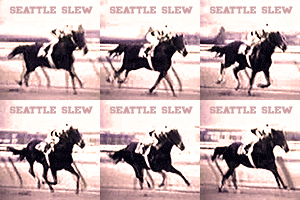
I love seeing traits from other breeds show up in modern TBs. There was a photo of War Emblem on the Blood Horse site looked alot like the Akhal-Teke in the link. I also noticed that certain TB lines seem to have that Akha-Teke metallic sheen to them, so that even on a dull gray day they seem to have a glow to them. Seattle Slew always seemed very Barb-like to me, a bit coarse and just roughly but well-made and I've seen that strange eye color of his in Barb horses too.
Nu
His dam, Pheasant, seems quite inbred, especially her sire, Bustard. The interesting look is at Carbineer:
http://www.allbreedpedigree.com/carbineer
Gypsy vanner? Irish horse?
If you look up Pheasant in the TB database you see a different pedigree.
The problem with the all-breed database is there are an awful lot of errors and unknown lines which some people feel free to ad their "assumed" lineage. There is no proof and comments should be made in the info lines, not on the pedigrees themselves.
That is why I am more inclined to go with the TB database. They do not allow just anyone to edit pedigrees, especially breed founders.
The pedigree you looked at(Pheasant in the All-breed database) lists a horse born in 2004?
LOL!!!
I had the same issue with the QH lines and I saw many errors there as well.