If you can look at Secretariat and think of where his bones are -- you need to strip off all the heavy muscle-- he's got the deep chest of the distance horse rather than a cylindrical barrel. He just had so much muscle, it is hard to see the underlying structure.
Without that 20 lb heart, which must have been both large and very efficient, Secretariat would likely have been a long sprinter.--He never broke very fast, and usually took some time to get rolling. Which would rule out Quarter Horse type distances. I always thought he looked more like a QH than a TB.
A number of the Bold Ruler's are very muscular, as was Bold Ruler himself.
Early patterns of the TB.
Moderators: Roguelet, hpkingjr, WaveMaster, Lucy
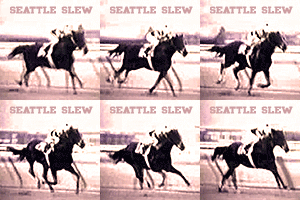
A number of the Bold Ruler's are very muscular, as was Bold Ruler himself.
Very true. I think Storm Cat has a lot of this as well(along with Northern Dancer traits).
Another trait that seems to come from Bold Ruler influence is the straight hind leg. Secretariat had it, Seattle Slew had it......Both had tremendous speed, even though Slew had more early speed IMO.
Shammy,
This thread is not to discourage anyone who doesn't feel the need to explore pedigrees farther back than 5 generations.
Your posts are welcome and most of this stuff is speculation.
I have been interested in "how" the TB came about and specifically what "types" or "breeds" where used in their background.
They are still a hybrid and still do not breed true to type.
Bill,
You rock!!! Thanks for that link!!!!!
-
Shammy Davis
- Chef de Race: Classic
- Posts: 4451
- Joined: Sat Oct 02, 2004 8:23 am
I posted:
I was reading SPEED & the TB last night and came to a section where the author proposed that speed was offered by the female line. I venture to guess that most people would stop and take a second look at that suggestion. We are always talking about the sire and the related character and quality that is passed to the offspring. No one ever says, its the "mare" you fool. (I'm a firm believer that it is the mare.)
Case in point is Somethingroyal. Everyone I know believes she offered the stamina quality and BR was the one that offered the speed. What comes to mind for me, as I'm interested more in distance and stamina breeding, is at what point in the female line does the speed quality have to be interjected for optimal success and is this a relationship to XFactor alone?
I think, in conclusion, that SECRETARIAT's conformation fits the sprinter style of TB. It didn't fit the classic distance IMHO. I think the points made related to fast and slow twitch muscles we'll give me pause to think more deeply into the issue, although I don't see that related specifically to SECRETARIAT'S conformation.
I was reading SPEED & the TB last night and came to a section where the author proposed that speed was offered by the female line. I venture to guess that most people would stop and take a second look at that suggestion. We are always talking about the sire and the related character and quality that is passed to the offspring. No one ever says, its the "mare" you fool. (I'm a firm believer that it is the mare.)
Case in point is Somethingroyal. Everyone I know believes she offered the stamina quality and BR was the one that offered the speed. What comes to mind for me, as I'm interested more in distance and stamina breeding, is at what point in the female line does the speed quality have to be interjected for optimal success and is this a relationship to XFactor alone?
-
xfactor fan
- Breeder's Cup Winner
- Posts: 2212
- Joined: Thu Sep 16, 2004 8:46 pm
Just to add a bit to the mtDNA thread.
Here's a link to chromosome count.
http://www.pedigreequery.com/forum/post ... db7e19a258
Domestic horses have 64 chromosomes (32 pairs) true wild horses, Przewalski's horses have 66 (33 pairs) Donkeys 62 (31 pairs).
Donkeys and horses combine to create mules which are sterile.
Horses and Przewalski's Horses can breed and create fertile offspring. In fact there can be a breeding herd with animals with 64, 65, and 66 chromosomes. This works because two of the domestic horse chromosomes have fused, but contains all the correct information.
Speculation is that somewhere in the distant past this mutation happened creating a herd with all three types of chromosomes counts. Isolation or selection created a herd with 64 chromosomes. These descendants are the modern domestic horses. This has led to some speculation that all domestic horses trace back to the same herd, and possibly one stallion.
Evidence to support this theory is the lack of variation in the equine Y chromosome.
Given how difficult the Przewalski's horse is to domesticate, I'm wondering if something in the creation of the new chromosome lends itself to domestication.
If there were tractable pre-historic horses, introductions of new "wild mares" could be made, and then selection for good disposition would select for horses with 64 chromosomes.
A bit off the topic of early development of the TB, but does explain the finding that there is no difference between the Y chromosomes of the three founding sire lines of the TB.
Which of course tosses out the whole concept of male tail lines.
Here's a link to chromosome count.
http://www.pedigreequery.com/forum/post ... db7e19a258
Domestic horses have 64 chromosomes (32 pairs) true wild horses, Przewalski's horses have 66 (33 pairs) Donkeys 62 (31 pairs).
Donkeys and horses combine to create mules which are sterile.
Horses and Przewalski's Horses can breed and create fertile offspring. In fact there can be a breeding herd with animals with 64, 65, and 66 chromosomes. This works because two of the domestic horse chromosomes have fused, but contains all the correct information.
Speculation is that somewhere in the distant past this mutation happened creating a herd with all three types of chromosomes counts. Isolation or selection created a herd with 64 chromosomes. These descendants are the modern domestic horses. This has led to some speculation that all domestic horses trace back to the same herd, and possibly one stallion.
Evidence to support this theory is the lack of variation in the equine Y chromosome.
Given how difficult the Przewalski's horse is to domesticate, I'm wondering if something in the creation of the new chromosome lends itself to domestication.
If there were tractable pre-historic horses, introductions of new "wild mares" could be made, and then selection for good disposition would select for horses with 64 chromosomes.
A bit off the topic of early development of the TB, but does explain the finding that there is no difference between the Y chromosomes of the three founding sire lines of the TB.
Which of course tosses out the whole concept of male tail lines.
The direct link to the Nasrullah photo is here http://www.circledhorses.com/Nasrullah.jpg Maybe that will load better. Otherwise do a google image search for Nasrullah.
I think Secretariat's conformation was an interesting blend of sprinter/stayer. His hindquarters were definitely sprinter, but he had a very large chest - so large that normal girths wouldn't fit, so he had the lungs/heart to carry the speed for a distance.
I've read a couple of different theories on speed vs distance inheritance. Marianna Haun advocates mating mares with staying influence and large hearts to 'speed' stallions like Bold Ruler and Mr. Prospector.
Another theory is that horses who have bloodline concentrations beyond five generations have stamina, whereas sprinters have close concentrations of bloodlines. There's a pretty good explanation of this theory here http://www.sport-horse-breeder.com/american-thoroughbred.html

I think Secretariat's conformation was an interesting blend of sprinter/stayer. His hindquarters were definitely sprinter, but he had a very large chest - so large that normal girths wouldn't fit, so he had the lungs/heart to carry the speed for a distance.
I've read a couple of different theories on speed vs distance inheritance. Marianna Haun advocates mating mares with staying influence and large hearts to 'speed' stallions like Bold Ruler and Mr. Prospector.
Another theory is that horses who have bloodline concentrations beyond five generations have stamina, whereas sprinters have close concentrations of bloodlines. There's a pretty good explanation of this theory here http://www.sport-horse-breeder.com/american-thoroughbred.html
A bit off the topic of early development of the TB, but does explain the finding that there is no difference between the Y chromosomes of the three founding sire lines of the TB.
Which of course tosses out the whole concept of male tail lines.
I don't mind at all the discussion about the evolution of the domestic horse.

I totally agree about the sire lines. Some people worry way too much about the disappearance of the other lines(Matchem, Herod)..Looks to me to be a natural phenomenon and people are wasting their time worrying about it.
Female lines seem to be where the genetic variation is coming from anyways.
As far as Matchem(Godolphin Barb) and Herod(Byerly Turk) goes, their genes are still in the pool and will always be. Nothing has disappeared.
That is why I laugh at sire line nuts. There are so many other lines to a pedigree.

aethervox,
That last link is VERY interesting. I have noticed these kind of patterns all the way to the beginning of the breed.
Unfortunately, some very primary patterns have never been written about.
The family #15 is very interesting and one of the oldest ones in the stud book.
I did some hypo's of some very interesting and successful early crosses.
Check these out:
Example 1
Example 2
Example 3
Example 4
I hope that the hypo mating feature works for all of you.
If not, compare the relationship of these horses:
Blank
Cade
Regulus
Babraham
Janus
Lath
Mogul
Shakespeare
Old England
Gower Stallion
Babraham Blank
Marlborough
Then pick around at some of the early derby winners, or champion racehorses of the time era.
Fascinating.
That last link is VERY interesting. I have noticed these kind of patterns all the way to the beginning of the breed.
Unfortunately, some very primary patterns have never been written about.
The family #15 is very interesting and one of the oldest ones in the stud book.
I did some hypo's of some very interesting and successful early crosses.
Check these out:
Example 1
Example 2
Example 3
Example 4
I hope that the hypo mating feature works for all of you.
If not, compare the relationship of these horses:
Blank
Cade
Regulus
Babraham
Janus
Lath
Mogul
Shakespeare
Old England
Gower Stallion
Babraham Blank
Marlborough
Then pick around at some of the early derby winners, or champion racehorses of the time era.
Fascinating.
diomed wrote:aethervox wrote:I also find it interesting that only one breed when crossed with the TB does NOT degrade it's speed...The Quarter Horse.
Which, to me, suggests that the "speed" gene is the same with both breeds.
That's hardly surprising since the Quarter Horse studbook is open to offspring of Quarter horses x Thoroughbreds and they've been breeding to some of the fastest Thoroughbreds for decades. There's also no 'live cover' rule so artificial insemination and embryo/oocyte transfer are allowed so stallions can sire a WHOLE lot of offspring and mares can have more than one foal per year.
Oh, I know aethervox....
Crazy stuff. Imagine if the TB was allowed to do the same.
What I am getting at is that even if a horse is say, 7/8 thoroughbred, and 1/8 Arabian.....The Arabian will inhibit the "speed" enough to downgrade them. That horse will be much faster than the original Arabian but will never compete with full blooded TBs, yet the QH seems to not do so.
I am convinced that there is a gene for speed they both inherit.
Even before the TB/QH cross breeding, the original native American QH was still as fast if not faster than the TB at short distances.
The background of the QH does go back to Little Janus, a unique TB, so there is something about that to investigate, I think.
It is rumored that his sire's family(Janus)is running horse/galloway since his 2nd dam is a full sister to Bald Galloway.
The descriptions of Little Janus are very much like a Quarter Horse and his ability to sire intense speed was legendary.
I find it very interesting that Little Janus is 3x2 to Points and her full brother Bald Galloway.
Hmmmm.....
The colonial era QHs were out of what were called "Chickasaw" mares and TB stallions, predominantly Janus and his sons and grandsons. These mares were obtained from the southern Indian tribes and were of Spanish origins, so they were probably Barbs. The interesting thing about the Januses was that when they were bred to TB mares, they produced the 4 mile heat runners but when they were bred to the Indian mares or mares of mixed Indian-TB breeding, they produced the Quarter milers.
The original mustangs and Indian ponies of the Western US were also predominantly of Spanish blood also, but to this were eventually added QH, Morgan, and Saddler/Foxtrotter/Walking Horse blood. Many of the foundation stallions of the QH breed came from areas like East Texas, Louisiana, Missouri and Illinois, and were mixed with the mustang and Indian pony mares (many of which were sold off by the US government after the Plains tribes surrendered). Whenever horsemen were looking to breed race horses, however, they bred their QH mares to TB stallions. This tendency increased with the establishment of the US Remount Service which brought well-bred TBs into many of the western states to stand for affordable stud fees.
QHs and TBs are cousins, and have been closely related since Colonial times.
Welcome to the discussion Linda d. 
I completely agree with you about the QH and their relation to the TB.
Janus(officially, Little Janus) often gets ignored in relation to the early formation of the American Thoroughbred.
Many of the top American Families started with a Janus cross.
There were many top TB stallions imported that either had Janus in their blood already or ties to his family(#15, Bald Galloway and his full sister, Points).
I read that Janus was a good 4 mile horse himself, but didn't really look the part and could pass on tremendous speed.
His closely related cousin, Babraham, was known for getting top class horses but appeared to be a different specimen physically. Babraham was a horse said to be well over 16h tall, very large for the time, whereas Janus was a small stocky horse(14.2h).
I think it's very telling about how the TB got their "turn of foot" if you compare the QH and it's background.
Spanish blood could very well be the source, if you consider the fact that the "Galloways" and/or "Hobbies", native British breeds, were the early ancestors of the TB and at one time during that history they raced them at short distances.
This could have been a tradition passed down by generation in Britain and carried into the Colonies.
The "type" of horse that the QH is based on(small, quick Barb(spanish) types) is probably VERY similar to the famous Hobby or Galloway strain beloved by the British breeders.
So, in essence, the American native horse could have been almost exactly like the British native horse, a breed that morphed into ponies due to "lost" Spanish imports.
I believe the Galloway was formed by Spanish horses lost due to war that became wild and eventually were tamed, much like the American Indian ponies.
I think the similarity has to make you wonder.
Now, where did the thoroughbred get its size?
The Turkish war horse?
I completely agree with you about the QH and their relation to the TB.
Janus(officially, Little Janus) often gets ignored in relation to the early formation of the American Thoroughbred.
Many of the top American Families started with a Janus cross.
There were many top TB stallions imported that either had Janus in their blood already or ties to his family(#15, Bald Galloway and his full sister, Points).
I read that Janus was a good 4 mile horse himself, but didn't really look the part and could pass on tremendous speed.
His closely related cousin, Babraham, was known for getting top class horses but appeared to be a different specimen physically. Babraham was a horse said to be well over 16h tall, very large for the time, whereas Janus was a small stocky horse(14.2h).
I think it's very telling about how the TB got their "turn of foot" if you compare the QH and it's background.
Spanish blood could very well be the source, if you consider the fact that the "Galloways" and/or "Hobbies", native British breeds, were the early ancestors of the TB and at one time during that history they raced them at short distances.
This could have been a tradition passed down by generation in Britain and carried into the Colonies.
The "type" of horse that the QH is based on(small, quick Barb(spanish) types) is probably VERY similar to the famous Hobby or Galloway strain beloved by the British breeders.
So, in essence, the American native horse could have been almost exactly like the British native horse, a breed that morphed into ponies due to "lost" Spanish imports.
I believe the Galloway was formed by Spanish horses lost due to war that became wild and eventually were tamed, much like the American Indian ponies.
I think the similarity has to make you wonder.
Now, where did the thoroughbred get its size?
The Turkish war horse?
-
Shammy Davis
- Chef de Race: Classic
- Posts: 4451
- Joined: Sat Oct 02, 2004 8:23 am
Shammy Davis wrote:diomed asked:Now, where did the thoroughbred get its size?
The Turkish war horse?
Maybe the predecessor to the Akhal Teke. So many of the historic paintings and drawings of the earlier periods appear so surreal that I find myself wondering if artistic liscense was involved.
Completely agree here.
Not all the artists of the era were particularly that way though.
George Stubbs painting of early racehorses are eerily Tukoman.
Check out this painting of Rufus

Here is a painting of an Arabian

Very obvious differences and Rufus looks very long and narrow, much like a Turkish horse.
I found some very interesting photos representing different breeds of horses.
The Neapolitan Courser was a favorite breed in Britain during the formation of the TB. Many were kept at the Hampton Court Stud and it wouldn't surprise me that they were crossed with running strains as well.
It is obvious the the prized "Hunting Horse" of the British isles had much of this blood. The Courser was a product of Spanish, Turk and Large Native horse(probably Draft) crosses.
Here is some photographic examples.
Old Drawing

Modern Coursers from Italy


The interesting thing about the Turkish horse is that they had an extra rib for body length, unlike the Arabian, and they carried their tails low(including while running) just like the TB.
The Barb also does this as well.
Perhaps the combination of Barb/Turk dominated the Arab tendency to carry the tail high?
The speedy barb is not a pretty horse but very balanced and many of their traits can be seen in the TB and QH.
Picture examples:


I also found a very enlightening video about the Spanish barb with a very rare modern example in it here;
http://www.britannica.com/eb/art-83833/ ... anish-Barb
When I see this horse on the video, it screams "sprinter". LOL!
Small in stature, compact, well-muscled, wide, balanced, somewhat plain and/or course.
The audio on the video made me think of Little Janus.
Descriptions of early thoroughbreds, arabs, etc.
I ran across a book on google the other day that can be downloaded in PDF format. http://books.google.com/books?id=02UCAAAAYAAJ&printsec=frontcover&dq=%22The+American+Race-turf+Register%22
I originally posted the link in the color forum at http://www.pedigreequery.com/forum/viewtopic.php?t=21069 because there was a description of a thoroughbred mare, foaled in 1823, which read:
What was interesting is the author/compiler distinguished between quarter race horses and regular race horses in pedigrees, and has the pedigrees in sections - imported, American, arabs/barbs and spanish.
It was interesting to read and, if you view it on Google, you can search in the book itself. It's an interesting resource for early pedigree research.
I originally posted the link in the color forum at http://www.pedigreequery.com/forum/viewtopic.php?t=21069 because there was a description of a thoroughbred mare, foaled in 1823, which read:
A beautiful dark brown mare, very well formed, interspersed all over her body with white hairs and spots, with two white hind feet, interspersed also with black streaks and spots, and a streak of white on her face...
What was interesting is the author/compiler distinguished between quarter race horses and regular race horses in pedigrees, and has the pedigrees in sections - imported, American, arabs/barbs and spanish.
It was interesting to read and, if you view it on Google, you can search in the book itself. It's an interesting resource for early pedigree research.
Paintings of the Godolphin Arabian/Barb


Photos and quotes courtesy of Bloodlines.net
So, what is the general opinion here?
Barb? Arabian?
I vote Barb.
This original portrait, by David Morier, is the only one known to have been done from life and is in the collection of the Marquis of Cholmondeley, Houghton Hall, Norfolk. At the bottom of the portrait is written: "The Original Picture taken at the Hills by D. Murrier. Painter to H:R:H. the Duke of Cumberland"
The George Stubbs portrait, an original painting in the William Woodward Collection, was probably copied from the Morier.
After a portrait by Ben Marshall, who was said to have had some sketches of the Godolphin Arabian that had been done from life. Marshall is credited with a "Portrait of an Arabian, 1796" [British Sporting Artists:176].
The Faber Print, 1753, after Morier, a copy of which made its way to Tulip Hill, Westriver, Maryland, the home of Samuel Galloway.
The Henry Roberts portrait, reproduced in the Sportsman's Pocket Companion, 1750c, after a drawing by James Roberts. This portrait was chosen by Theodore Andrea Cook to illustrate his book A History of the English Turf and is said to be from the engraving by Roberts at Cumberland Lodge.
The J. N. Sartorius portrait in the collection of Lord Rosebery at The Durdans.
Photos and quotes courtesy of Bloodlines.net
So, what is the general opinion here?
Barb? Arabian?
I vote Barb.
Last edited by diomed on Thu Jun 19, 2008 7:22 am, edited 1 time in total.