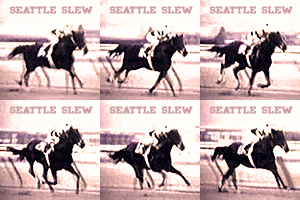
There is a stallion standing right around the corner from my house that should have been heavily promoted to breed more QH foals. He has been bred to both but doesn't have many foals. Too bad. He was a pure sprinter and champion from Argentina, running with and beating Gold Spring, etc in his native country.
He is quite a specimen to say the least. He looks so much like an appendix QH to me. I have other pictures of him, but I have not scanned them yet.
There is a pic on TB pedigree query.
http://www.pedigreequery.com/pancho+press
Early patterns of the TB.
Moderators: Roguelet, hpkingjr, WaveMaster, Lucy
-
Matchemforever
- Maiden Special Weight
- Posts: 169
- Joined: Wed May 14, 2008 12:07 pm
Elles, I like the look of your guy. He looks like a smooth blending of the TB and QH, not pieces of one here and another there.
After looking through some of the sites and reading here and there, it just seems like the early QH breeders just tended to use the TB they had available. Some of those appear to have been remount stallions.
So again, there seems to be something back in the history that links up gene-wise and produces that QH look. Then after several generations without a TB cross, the "type" appears to be pretty set.
What I think, and it's only my opinion, is like the warmblood that just tends to get heavier and more ponderous without adding back in TB, the QH tends to do the same thing- with the exception of Three Bars and Impressive. Impressive was mostly TB yet one of the extreme, muscle bound halter types. So maybe I've just disproved my own theory?
My idea of a good QH is kind of a TB frame, but a bit longer, good long hip, wider back, broader loin, and the muscling carried well down into the legs. The leg muscling is where some of the appendix lack. Not just the rear end, but the gaskins and forearms, too. Perhaps the knees and hocks lower set. I can't imagine a QH getting down to cut a cow, stop a calf, or do a reining spin on the high knee/hocks of some of the TB.
Re: Jumping
I know Holstein made extensive use of the Hampton line through Dark Ronald and others. Hampton did some steeplechasing. His sire, Lord Clifton, although a desendent of Eclipse, seems to have a fair amount of Highflyer in the back. Hampton's dam, not much. I expect the Holstein breeders know a thing or two about TB jumping bloodlines.
Fair Play and his get were also producers of jumpers. Man O' War's dam, Mahubah, was out of a Hampton bred mare through Merry Hampton. I haven't taken it further back to look for Highflyer.
So now I've got a question. Is jumping more heritable from the sire or dam? Sires of jumpers are identified, but are there any mares the consistently produce jumpers?
I'd also like to know that when it comes to breakdowns involving bone, does a muscle/ligament failure preceed the bone breakdown? I mean, if the ligaments, tendons, and muscles give way or tire, doesn't that make the bone the last resort of stress?
After looking through some of the sites and reading here and there, it just seems like the early QH breeders just tended to use the TB they had available. Some of those appear to have been remount stallions.
So again, there seems to be something back in the history that links up gene-wise and produces that QH look. Then after several generations without a TB cross, the "type" appears to be pretty set.
What I think, and it's only my opinion, is like the warmblood that just tends to get heavier and more ponderous without adding back in TB, the QH tends to do the same thing- with the exception of Three Bars and Impressive. Impressive was mostly TB yet one of the extreme, muscle bound halter types. So maybe I've just disproved my own theory?
My idea of a good QH is kind of a TB frame, but a bit longer, good long hip, wider back, broader loin, and the muscling carried well down into the legs. The leg muscling is where some of the appendix lack. Not just the rear end, but the gaskins and forearms, too. Perhaps the knees and hocks lower set. I can't imagine a QH getting down to cut a cow, stop a calf, or do a reining spin on the high knee/hocks of some of the TB.
Re: Jumping
I know Holstein made extensive use of the Hampton line through Dark Ronald and others. Hampton did some steeplechasing. His sire, Lord Clifton, although a desendent of Eclipse, seems to have a fair amount of Highflyer in the back. Hampton's dam, not much. I expect the Holstein breeders know a thing or two about TB jumping bloodlines.
Fair Play and his get were also producers of jumpers. Man O' War's dam, Mahubah, was out of a Hampton bred mare through Merry Hampton. I haven't taken it further back to look for Highflyer.
So now I've got a question. Is jumping more heritable from the sire or dam? Sires of jumpers are identified, but are there any mares the consistently produce jumpers?
I'd also like to know that when it comes to breakdowns involving bone, does a muscle/ligament failure preceed the bone breakdown? I mean, if the ligaments, tendons, and muscles give way or tire, doesn't that make the bone the last resort of stress?
-
vineyridge
- Grade III Winner
- Posts: 1195
- Joined: Fri Jan 28, 2005 9:41 am
Re: jumping
If you look at the New Twist dynasty of US jumpers, the sire line of Bonne Nuit is Thormanby/Atlantic. The founding dam line is Bonne Cause, and she is doubled in New Twist's dam Sisterly Love through her daughter Brave Bonnie by Great War (Man O' War). Bonne Cause is Elf/Upas/Dollar. I think that the Twist line inherited both through the sires and the dams, because the Great Chaser Battleship is Man O' War on top and Quarantaine by SeaSick/Elf/Upas/Dollar on the bottom. There are some other mares who have produced Great Chasers--Ponova and her daughter Pova are one pair. They are both heavy with Lines to Hampton (whom I adore in sport horses), but they are also filled with Pocahontas and The Flying Duchess (dam of Galopin) who are Woodpecker line Herod. When crossed with the Man O' War lines they produced several National Champion chasers. Mumtaz Mahal is Woodpecker/Herod, and I think she brings jumping into Royal Charger and Nasrullah.
The West Australian line is the only living Matchem line left, and they have a long history of producing jumping horses. I haven't done as much research on the dams in this line because they don't jump out at one as much as the others do.
Hampton appears to be much more than 50% Not Eclipse sire lines. Obviously all but one of those come through mares.
I think the Saint Simons get their jump from The Flying Duchess.
Jumping may be more or less equal opportunity; or if it is sex linked, it needs to be present on both sides to express fully.
Mahubah has a lot of lines to Woodpecker through Pocahontas. And many more to Herod on her dam side--Cain, Necklace and Macaroni are all Highflyer, as is Queen Mary, who is almost completely Herod and mostly Highflyer. If you consider the effect that Queen Mary and Pocahontas had on the TB . . .
Ponova and Pova and Quarantaine are from the same female family as Queen Mary--family 10. Black Duchess and Pocahontas are both from female family 3.
Bonne Cause is female family 5. So is Mother In Law. 1, 5 and 10 are especially good for jumpers.
If you look at the New Twist dynasty of US jumpers, the sire line of Bonne Nuit is Thormanby/Atlantic. The founding dam line is Bonne Cause, and she is doubled in New Twist's dam Sisterly Love through her daughter Brave Bonnie by Great War (Man O' War). Bonne Cause is Elf/Upas/Dollar. I think that the Twist line inherited both through the sires and the dams, because the Great Chaser Battleship is Man O' War on top and Quarantaine by SeaSick/Elf/Upas/Dollar on the bottom. There are some other mares who have produced Great Chasers--Ponova and her daughter Pova are one pair. They are both heavy with Lines to Hampton (whom I adore in sport horses), but they are also filled with Pocahontas and The Flying Duchess (dam of Galopin) who are Woodpecker line Herod. When crossed with the Man O' War lines they produced several National Champion chasers. Mumtaz Mahal is Woodpecker/Herod, and I think she brings jumping into Royal Charger and Nasrullah.
The West Australian line is the only living Matchem line left, and they have a long history of producing jumping horses. I haven't done as much research on the dams in this line because they don't jump out at one as much as the others do.
Hampton appears to be much more than 50% Not Eclipse sire lines. Obviously all but one of those come through mares.
I think the Saint Simons get their jump from The Flying Duchess.
Jumping may be more or less equal opportunity; or if it is sex linked, it needs to be present on both sides to express fully.
Mahubah has a lot of lines to Woodpecker through Pocahontas. And many more to Herod on her dam side--Cain, Necklace and Macaroni are all Highflyer, as is Queen Mary, who is almost completely Herod and mostly Highflyer. If you consider the effect that Queen Mary and Pocahontas had on the TB . . .
Ponova and Pova and Quarantaine are from the same female family as Queen Mary--family 10. Black Duchess and Pocahontas are both from female family 3.
Bonne Cause is female family 5. So is Mother In Law. 1, 5 and 10 are especially good for jumpers.
Thread Killer Extraordinaire
This one could jump the moon:
http://www.sporthorse-data.com/d?i=2895 ... =10"a=
An other more recent Tb whose offspring are doing very well at grand prix jumping (in Europe) is Hand in Glove.
http://www.google.nl/search?hl=nl&q=%22 ... eken&meta=
And in Holland we had in the past Abgar who gave good jumping ability.
http://www.roelofsgroep.nl/uploads/gene ... 20crop.jpg
http://www.google.nl/search?um=1&hl=nl& ... a=N&tab=iw
Great Stallions
Abernant also sired Abgar xx, another major jumping sire in Dutch breeding. Abgar has another Bay Ronald cross on his dam’s sire, she is by the Djebel son, ...
www.horsemagazine.com/BREEDINGBARN/GREA ... onald.html
http://www.sporthorse-data.com/d?i=2895 ... =10"a=
An other more recent Tb whose offspring are doing very well at grand prix jumping (in Europe) is Hand in Glove.
http://www.google.nl/search?hl=nl&q=%22 ... eken&meta=
And in Holland we had in the past Abgar who gave good jumping ability.
http://www.roelofsgroep.nl/uploads/gene ... 20crop.jpg

http://www.google.nl/search?um=1&hl=nl& ... a=N&tab=iw
Great Stallions
Abernant also sired Abgar xx, another major jumping sire in Dutch breeding. Abgar has another Bay Ronald cross on his dam’s sire, she is by the Djebel son, ...
www.horsemagazine.com/BREEDINGBARN/GREA ... onald.html
-
vineyridge
- Grade III Winner
- Posts: 1195
- Joined: Fri Jan 28, 2005 9:41 am
The number of Woodpecker lines in Laudanum through both mares and stallions is overwhelming.
I know Boran passed on the jump gene, because some of his female offspring are in the United States and have been very successful show horses (hunter types). The fellow who stood Laudanum makes the statement in his Horse Magazine interview that Mourne himself was the founder of a line of talented jumping horses. Norseman got jumpers.
Laudanum is FF 10. Hand In Glove is FF5.
Add Lavendula I to mares that pass on the jump gene.
Ksar ( http://www.pedigreequery.com/ksar sired a line of jumpers in the US that were used at the International GP level. And take a look at the pedigrees of these jumpers--
Jonlyle (Idle Dice) and Sinjon http://www.pedigreequery.com/sinjon
Possible recipe for breeding the jump--Matchem, one line each of Tourbillon and Roi Herode, and FF 1, 5, or 10 or through a mare with known jumper relatives, like Lavendula.
I know Boran passed on the jump gene, because some of his female offspring are in the United States and have been very successful show horses (hunter types). The fellow who stood Laudanum makes the statement in his Horse Magazine interview that Mourne himself was the founder of a line of talented jumping horses. Norseman got jumpers.
Laudanum is FF 10. Hand In Glove is FF5.
Add Lavendula I to mares that pass on the jump gene.
Ksar ( http://www.pedigreequery.com/ksar sired a line of jumpers in the US that were used at the International GP level. And take a look at the pedigrees of these jumpers--
Jonlyle (Idle Dice) and Sinjon http://www.pedigreequery.com/sinjon
Possible recipe for breeding the jump--Matchem, one line each of Tourbillon and Roi Herode, and FF 1, 5, or 10 or through a mare with known jumper relatives, like Lavendula.
Thread Killer Extraordinaire
Going back to genetics for a moment.
Well, now having a chance to read both articles, I have a few comments.
First of all, 'statistically significant' is a hotly debated term amongst systematicists ( I work with some invertebrate systematicists, so I've heard a lot about that).
Jansen, et al. pointed out that several clusters were interesting with regard to geographic distribution and breed. They excluded modern interbreeding (as far as possible) by only using horses with 'a documented geographic origin of their maternal ancestry that corresponds to the origin of the respective breed. For example, if the earliest documented maternal ancestor of a horse sample was Andalusian by breed, but born in Germany, then it was excluded, even though the Spanish origin of Andalusians is not in dispute.' Given that, they pointed out that of the 71 horses identified by breed that belonged to clade D1, the highest percentage of the gene was found in breeds originating from the Iberian peninsula and NW Africa (54% of barbs tested, 50% of Andalusians, 56% of Lusitanos, 31% of Mustangs). Please note that I'm not including any breeds in the previous list that had less than 4 individuals tested - that omits the Yunnan, Friesian, and Belgian horses, among others.
Since McGahern, et al., didn't include any of the Iberian/NW African breeds in their study (The Eastern Cohort of breeds contained horses from Arabia, China, Egypt, Iran, Japan, Korea and Russia, while the Western cohort of breeds contained horses from Austria, Belgium, Denmark, Germany, Iceland, Ireland, Netherlands, Norway and UK), so they may have missed any correlation between clade D1 and the Iberian/NW African breeds.
It will be interesting watching further developments as more horses are tested.
As far as the relative scarcity of 'Arab' mtDNA types in the thoroughbred, I'm not surprised. The Bedouin prized their mares highly, and would be more amenable to selling their stallions to Europeans. I have to wonder if the mares sold to the Europeans were, in fact, pure-blooded. It wouldn't surprise me if they were a mixture of breeds and sold to the unsuspecting Europeans as 'pure-blooded'. Just a thought.
Pan Zareta wrote:aethervox wrote:Do you have a citation for this? It wasn't mentioned in the article the figure came from, and I'd certainly like to read more about the subject.
McGahern, A. et al. "Evidence for biogeographic patterning of mitochondrial DNA sequences in Eastern horse populations." (Short Communication) in Animal Genetics 37(5)494-497. Oct. 2006.
"Until now, no clear geographic affiliation of clades has been apparent. In this study, AMOVA analyses have revealed a significant non-random distribution of the diversity among equine populations when seven newly sequenced Eurasian populations were examined in the context of previously published sequences. The association of Eastern mtDNA types in haplogroup F was highly significant..."
Well, now having a chance to read both articles, I have a few comments.
First of all, 'statistically significant' is a hotly debated term amongst systematicists ( I work with some invertebrate systematicists, so I've heard a lot about that).
Jansen, et al. pointed out that several clusters were interesting with regard to geographic distribution and breed. They excluded modern interbreeding (as far as possible) by only using horses with 'a documented geographic origin of their maternal ancestry that corresponds to the origin of the respective breed. For example, if the earliest documented maternal ancestor of a horse sample was Andalusian by breed, but born in Germany, then it was excluded, even though the Spanish origin of Andalusians is not in dispute.' Given that, they pointed out that of the 71 horses identified by breed that belonged to clade D1, the highest percentage of the gene was found in breeds originating from the Iberian peninsula and NW Africa (54% of barbs tested, 50% of Andalusians, 56% of Lusitanos, 31% of Mustangs). Please note that I'm not including any breeds in the previous list that had less than 4 individuals tested - that omits the Yunnan, Friesian, and Belgian horses, among others.
Since McGahern, et al., didn't include any of the Iberian/NW African breeds in their study (The Eastern Cohort of breeds contained horses from Arabia, China, Egypt, Iran, Japan, Korea and Russia, while the Western cohort of breeds contained horses from Austria, Belgium, Denmark, Germany, Iceland, Ireland, Netherlands, Norway and UK), so they may have missed any correlation between clade D1 and the Iberian/NW African breeds.
It will be interesting watching further developments as more horses are tested.
As far as the relative scarcity of 'Arab' mtDNA types in the thoroughbred, I'm not surprised. The Bedouin prized their mares highly, and would be more amenable to selling their stallions to Europeans. I have to wonder if the mares sold to the Europeans were, in fact, pure-blooded. It wouldn't surprise me if they were a mixture of breeds and sold to the unsuspecting Europeans as 'pure-blooded'. Just a thought.
-
Matchemforever
- Maiden Special Weight
- Posts: 169
- Joined: Wed May 14, 2008 12:07 pm
I was rereading this article on families and stamina:
http://tinyurl.com/5kes96
So I thought I'd take a look at their ideas that families 2, 15, 16 would tend towards sprinters and 4, 11, longer distances. Anything else would seem to fall in the middle.
(With just two examples, this is extremely small sampling)
Man O' War- 4c. That means that Mahubah was 4c but her sire, Rock Sand, is also a 4, 4n. Fairy Gold, dam of Fair Play, is 9e. Hampton, sire of Mahubah's dam, is 10a. So it looks like MOW could have just gotten better at longer distances, if the idea that stamina can run in families plays out. (This is simplistic because there are tons of other variables, I know!)
Secretariat- 2s (???) Something Royal is a 2s, sprinting. Her sire, Princequillo, known for producing stayers if I recollect right, is out of Cosquillo who is 1b. So I looked up top but Miss Disco is 8d.
Man O' War had nothing that looked to take away stamina, but Secretariat had mostly middle distance families. Yet MOW could sprint, losing only 1 race as a two year old-and nearly overcoming that bad race, and Secretariat could run long.
Seems like we're back to horses that are almost freaks, in a good way. Trying to pinpoint what lightning strike is in that bottle will probably elude us.
Adding Domino-
I don't know how the American families come into this, whether the numbers match the English numbers, just with the letter designation added to define that branch of the line as American?
If so. Domino's sire, Himyar, was A-15 and his sire, Alarm's dam is 15d.
But on the bottom side, Reel is 23b, Lida A18, and Lexington's dam, Alice Carneal, is 12b. IF the American "15" is about the same family as the English 15, then Domino seems to have tended towards the sire line for his speed, with nothing in the dam line to negate it.
(That's if the idea that certain families could run true to their numbers is valid)
http://tinyurl.com/5kes96
So I thought I'd take a look at their ideas that families 2, 15, 16 would tend towards sprinters and 4, 11, longer distances. Anything else would seem to fall in the middle.
(With just two examples, this is extremely small sampling)
Man O' War- 4c. That means that Mahubah was 4c but her sire, Rock Sand, is also a 4, 4n. Fairy Gold, dam of Fair Play, is 9e. Hampton, sire of Mahubah's dam, is 10a. So it looks like MOW could have just gotten better at longer distances, if the idea that stamina can run in families plays out. (This is simplistic because there are tons of other variables, I know!)
Secretariat- 2s (???) Something Royal is a 2s, sprinting. Her sire, Princequillo, known for producing stayers if I recollect right, is out of Cosquillo who is 1b. So I looked up top but Miss Disco is 8d.
Man O' War had nothing that looked to take away stamina, but Secretariat had mostly middle distance families. Yet MOW could sprint, losing only 1 race as a two year old-and nearly overcoming that bad race, and Secretariat could run long.
Seems like we're back to horses that are almost freaks, in a good way. Trying to pinpoint what lightning strike is in that bottle will probably elude us.
Adding Domino-
I don't know how the American families come into this, whether the numbers match the English numbers, just with the letter designation added to define that branch of the line as American?
If so. Domino's sire, Himyar, was A-15 and his sire, Alarm's dam is 15d.
But on the bottom side, Reel is 23b, Lida A18, and Lexington's dam, Alice Carneal, is 12b. IF the American "15" is about the same family as the English 15, then Domino seems to have tended towards the sire line for his speed, with nothing in the dam line to negate it.
(That's if the idea that certain families could run true to their numbers is valid)
Last edited by Matchemforever on Mon Jul 14, 2008 2:43 pm, edited 1 time in total.
-
Matchemforever
- Maiden Special Weight
- Posts: 169
- Joined: Wed May 14, 2008 12:07 pm
Back to Pocahontas:
http://www.tbheritage.com/Portraits/Pocahontas.html
"Pocahontas may have been run over her head, but it may also be that her ability was compromised by being a "roarer," or "broken in the wind." This is a respiratory problem that in this case may have been passed down through the female line for at least three generations, as both Marpessa and her dam Clare were also said to be roarers."
The more I read, the more it seems that it has always been that horses were put to stud or the broodmare band regardless of other issues. While Pocahontas proved to be of immense influence, it also seemed to come at an occasional price. It just may be that at long last, the practice could be catching up to the breed. As I read it, using brilliant performers with issues in the stud is nothing new.
I began by trying to trace the probable double X back on Pocahontas. The more I look at it, via, "It could only have been this mare, (with a stallion) or both with a mare, the more I think that there is high probability that all three foundation stallions carried the big heart gene, and may well have been why they became so prominent. Just not really for what the male line contributed, but what the female lines of these stallions did- with a little help from the Bald Galloways, Martin family...
Which got me to chewing on an odd thought- maybe the best thing a great sire does it NOT override the female contribution. And if he does, his genes show up best another generation away, say, in his daughters?
(Or maybe I just need some sleep)
http://www.tbheritage.com/Portraits/Pocahontas.html
"Pocahontas may have been run over her head, but it may also be that her ability was compromised by being a "roarer," or "broken in the wind." This is a respiratory problem that in this case may have been passed down through the female line for at least three generations, as both Marpessa and her dam Clare were also said to be roarers."
The more I read, the more it seems that it has always been that horses were put to stud or the broodmare band regardless of other issues. While Pocahontas proved to be of immense influence, it also seemed to come at an occasional price. It just may be that at long last, the practice could be catching up to the breed. As I read it, using brilliant performers with issues in the stud is nothing new.
I began by trying to trace the probable double X back on Pocahontas. The more I look at it, via, "It could only have been this mare, (with a stallion) or both with a mare, the more I think that there is high probability that all three foundation stallions carried the big heart gene, and may well have been why they became so prominent. Just not really for what the male line contributed, but what the female lines of these stallions did- with a little help from the Bald Galloways, Martin family...
Which got me to chewing on an odd thought- maybe the best thing a great sire does it NOT override the female contribution.
And if he does, his genes show up best another generation away, say, in his daughters?
(Or maybe I just need some sleep)
-
Bill from WA
- Breeder's Cup Contender
- Posts: 1936
- Joined: Thu Sep 16, 2004 11:20 am
- Location: Mountlake Terrace, WA
Here is a great site that may offer some help.
Bill
http://www.bloodlines.net/TB/Families/T ... erican.htm
Bill
http://www.bloodlines.net/TB/Families/T ... erican.htm
Hold fast to dreams, for if dreams die, life is like a broken winged bird that cannot fly.
Langston Hughes
Langston Hughes
-
Pan Zareta

- Breeder's Cup Winner
- Posts: 2074
- Joined: Wed Dec 22, 2004 10:55 am
- Location: west TX boonies
aethervox wrote:First of all, 'statistically significant' is a hotly debated term amongst systematicists ( I work with some invertebrate systematicists, so I've heard a lot about that).
The specific method used to determine significance was identified in the article. That should not be taken to infer that (1)all systemacticists would agree with it, or (2)I understood it...

Fwiw, I found the association betw Clade D & Spanish stock quite intriguing, especially since the largest cluster of haplotypes in the TB's sampled by Hill 2002 was in the same clade.
It will be interesting watching further developments as more horses are tested.
Question for you, Bill, or anyone else who might be able to offer illumination - Harrison 2006 found diversity in the non-D-loop ('functional', 'coding') mtDNA among individuals with the same D-loop variant. (The D-loop segment used for that study was roughly the same used by other researchers incl. Hill.)
As Harrison points out the D-loop is "supposedly more hypervariable". This is regarded as a constant across most species. Is the equine an exception to the rule? Or could the haplotypes identified in the TB by Harrison, Hill, et al. be further refined by sequencing more/all of the D-loop? (I've asked this question of an author of one of the studies mentioned, and received a circuitous reply that didn't amount to an answer.)
As far as the relative scarcity of 'Arab' mtDNA types in the thoroughbred, I'm not surprised.
To what extent are mtDNA haplotypes identified w/in the Arab concentrated in clade/cluster/haplogroup F?
matchemforever wrote:IF the American "15" is about the same family as the English 15
Circumstantial evidence suggests American family 15 (A15) is a branch of Lowe (English) Family 19.
The small American family a86 that I've mentioned previously *may* link up w/ Lowe family 15. It didn't really flourish until it entered the QH.
The small American family a86 that I've mentioned previously *may* link up w/ Lowe family 15. It didn't really flourish until it entered the QH.
That would be very interesting indeed.
Another family that I see a QH connection to is the a90 family.
Uncle Jimmie Grey is from that line and he's HUGE in early QH families.
The other family that is splattered in QH pedigrees is A1 through Maria West.
-
Bill from WA
- Breeder's Cup Contender
- Posts: 1936
- Joined: Thu Sep 16, 2004 11:20 am
- Location: Mountlake Terrace, WA
More interesting stuff.
http://www.jstage.jst.go.jp/article/jjp ... 5/563/_pdf
http://biocomplexity.indiana.edu/jglazi ... thesis.pdf
Résumé / Abstract
The hypervariable D-loop region of mitochondrial DNA (mtDNA) was amplified with the polymerase chain reaction using total horse DNA samples. Analysis of single strand conformation polymorphism (SSCP) of denatured amplification products was carried out by native polyacrylamide (8%) gel electrophoresis followed by silver staining. As many as 15 distinct SSCP variants were revealed when screening a total of 78 maternally unrelated horses representing five different breeds. All breeds showed a high degree of polymorphism and the estimated probability (PImt) that two maternally unrelated individuals have, by chance, identical SSCP variants varied between 0.14 and 0.30. We detected no heteroplasmy or deviations from strict and stable maternal inheritance when examining four maternal lineages, each represented by six to eight horses, separated by up to five generations from a common ancestral mare. The study establishes a simple screening method for detecting equine mtDNA types, which can be applied for tracing maternal genealogies and for association studies.
Revue / Journal Title
Animal genetics ISSN 0268-9146 CODEN ANGEE3
Source / Source
1995, vol. 26, no3, pp. 193-196 (17 ref.)
Bill
http://www.jstage.jst.go.jp/article/jjp ... 5/563/_pdf
http://biocomplexity.indiana.edu/jglazi ... thesis.pdf
Résumé / Abstract
The hypervariable D-loop region of mitochondrial DNA (mtDNA) was amplified with the polymerase chain reaction using total horse DNA samples. Analysis of single strand conformation polymorphism (SSCP) of denatured amplification products was carried out by native polyacrylamide (8%) gel electrophoresis followed by silver staining. As many as 15 distinct SSCP variants were revealed when screening a total of 78 maternally unrelated horses representing five different breeds. All breeds showed a high degree of polymorphism and the estimated probability (PImt) that two maternally unrelated individuals have, by chance, identical SSCP variants varied between 0.14 and 0.30. We detected no heteroplasmy or deviations from strict and stable maternal inheritance when examining four maternal lineages, each represented by six to eight horses, separated by up to five generations from a common ancestral mare. The study establishes a simple screening method for detecting equine mtDNA types, which can be applied for tracing maternal genealogies and for association studies.
Revue / Journal Title
Animal genetics ISSN 0268-9146 CODEN ANGEE3
Source / Source
1995, vol. 26, no3, pp. 193-196 (17 ref.)
Bill
Hold fast to dreams, for if dreams die, life is like a broken winged bird that cannot fly.
Langston Hughes
Langston Hughes
-
Bill from WA
- Breeder's Cup Contender
- Posts: 1936
- Joined: Thu Sep 16, 2004 11:20 am
- Location: Mountlake Terrace, WA
More.
http://www.abc.net.au/rn/scienceshow/st ... 460637.htm
http://pt.wkhealth.com/pt/re/agen/abstr ... 29!8091!-1
http://www.abc.net.au/rn/scienceshow/st ... 460637.htm
http://pt.wkhealth.com/pt/re/agen/abstr ... 29!8091!-1
Last edited by Bill from WA on Tue Jul 15, 2008 11:27 am, edited 1 time in total.
Hold fast to dreams, for if dreams die, life is like a broken winged bird that cannot fly.
Langston Hughes
Langston Hughes
From what I understand, the hypervariablility (changing at a rate much faster than average) in mtDNA mainly occurs in the control region (CR) of the mtDNA, and then only at certain 'sites' in that region.
The problem is that they've found different mutations in human mtDNA CRs in different tissues of the same person, sometimes even in different hairs! See http://www.pubmedcentral.nih.gov/articlerender.fcgi?artid=151313
I think that the sites that are used for population studies are the ones that are consistently passed down from mother to offspring with little or no change so they can trace the families.
The problem is that they've found different mutations in human mtDNA CRs in different tissues of the same person, sometimes even in different hairs! See http://www.pubmedcentral.nih.gov/articlerender.fcgi?artid=151313
I think that the sites that are used for population studies are the ones that are consistently passed down from mother to offspring with little or no change so they can trace the families.
-
Pan Zareta
- Breeder's Cup Winner
- Posts: 2074
- Joined: Wed Dec 22, 2004 10:55 am
- Location: west TX boonies
Bill, thanks very much for the links. Absent additional segregating sites in the D-loop, the only thing I can think of that would explain Harrison's finding of diversity in the functional mt genes among individuals of identical D-loop haplotype is that two or more distinctly different aboriginal mares (almost certainly within haplogroup D) mutated over the millenia to the same D-loop haplotype, while acquiring and/or conserving limited diversity of 'functional' genes.
D-loop = control region = hypervariable region. Most equine studies have sampled roughly the same # of bp between 154xx - 158xx in the D-loop.
Heteroplasmy. In most cases all cells have a mixture of normal and mutant mitochondria. In the functional region it's usually associated with some degree of pathology. In the D-loop it's one way mutations arise and persist. Xu et al. 1994 fully sequenced equine mtDNA and documented its "extensive heteroplasmy of the control region". All subsequent studies of equine mtDNA cite that report, and presumably this factor has been taken into account in the presentation of findings and conclusions.
aethervox wrote:From what I understand, the hypervariablility (changing at a rate much faster than average) in mtDNA mainly occurs in the control region (CR) of the mtDNA, and then only at certain 'sites' in that region.
D-loop = control region = hypervariable region. Most equine studies have sampled roughly the same # of bp between 154xx - 158xx in the D-loop.
The problem is that they've found different mutations in human mtDNA CRs in different tissues of the same person, sometimes even in different hairs!
Heteroplasmy. In most cases all cells have a mixture of normal and mutant mitochondria. In the functional region it's usually associated with some degree of pathology. In the D-loop it's one way mutations arise and persist. Xu et al. 1994 fully sequenced equine mtDNA and documented its "extensive heteroplasmy of the control region". All subsequent studies of equine mtDNA cite that report, and presumably this factor has been taken into account in the presentation of findings and conclusions.