I was thinking.....if sire lines are the most genetically irrelevant (science has proven that this is so) than why not base nicks on female families (mitrochondrial DNA)? It would be pretty easy to do to see if, for example, 8-C nicks with 14-C. This seems to be a better method.
Your thoughts.........
New Nick method
Moderators: Roguelet, hpkingjr, WaveMaster
-
soft hearted
- Maiden Special Weight
- Posts: 109
- Joined: Fri Aug 22, 2008 3:16 am

 LOTS!
LOTS!pokeyman wrote:I was thinking.....if sire lines are the most genetically irrelevant (science has proven that this is so) than why not base nicks on female families (mitrochondrial DNA)? It would be pretty easy to do to see if, for example, 8-C nicks with 14-C. This seems to be a better method.
Your thoughts.........
I partially agree - study the female family & useful breeding patterns are likely to reveal themselves.
We have mares whose families have very distinct preferences for other female families. When I run a sire line nick on them, I almost never get a good nick, but know the family has had success with the cross & try it anyway.
But I disagree that the stallion is generally irrelevant. Obviously mitochondrial DNA means the mare gives the baby something the stallion cannot. And she teaches the foal as well, so nurture's on her side. But we also have mares whose families have a very distinct preference for a particular sire line & often they do not care which one of his sons - or daughers - they get to him through. It would be as foolish to ignore the top half of the pedigree as to ignore the bottom half.
As an example, one mare's family is especially fond of Turn-To. But that family's all-time top runner is by a Mr. Prospector sire whose dam happens to be by Cyane, a Turn-To son. Other folks owning this runner's female relatives are flocking to the Mr. P stallion & his sons & I'm looking at stallions from his female family. In fact, many Turn-To line stallions run to a particular body type & it might not be the sire line, but the body type, which is important. The fact you can frequently get it via that sire line might be what makes the line a good cross. Turns out that particular Mr. P son is built a lot like his dam's sire.
But all that ignores the interior of the pedigree. There are a few horses - mares & stallions - I look for in the interior of the pedigree because they seem to always be found in sound, tough horses who raced long, hard & successfully.
If you have a good state-bred program, you want those tough, hardknocking race horses to keep sending checks home for years!
BUt back to the interior of a pedigree --
I looked at one stallion pretty hard because I liked him & he had successful offspring, but I couldn't seen the pattern that would convince me to spend the money for the stud fee. There was no family affinity that I could find; the nicks unhelpfully told me he liked Mr. P. But after literally looking at the 5-generation pedigree of every successful offspring, it turns out many [but not all] are out of daughters or granddaughters of Mr. P's son Conquistador Cielo whose 2nd or 3rd dam was by Vertex.
No nick system that looks solely tail male or tail female will find that, although softwares like TesioPower, which shows patterns, or G1 Goldmine might - and even G1 Goldmine focuses on graded stakes winners, not hard-knocking racehorses, so would ignore the patterns of lesser mortals, anyway.
After all that, I also look at race record & then conformation trumps all, any way.
soft hearted wrote:Sounds great. I think Cool
The only problem is really.. the data.
Mares don't GIVE as much "data" as any stallion does in her lifetime (which, of course, is the point). So data would be limited so much more.
Other than that.. PLEASE - give it a shot! I'll look Laughing LOTS!
The data's out there; you just have to work harder to get it - and you have to pay for some of it.
I buy the 4 generation unedited pedigree from equineline. I call it the good, the bad & the ugly of the immediate family. You not only see the places where a cross worked well [the part they show you in an auction catalog] but also the 20 times the exact same cross didn't work at all [so you don't get overly excited]. I also pay the money to use the hypomating & family numbers on pedigreequery because I can find female family relationships easier that way. AND I pull a race record with charts so I can try to figure out if the mare earned her money because of good handling or despite bad handling, among other things [like surface preference & distance preference, and whether it was in tons of bottom level statebred claiming races or a nice race career primarily at the allowance level or above.]
And it is a lot of work. But here's where I really agree with pokeyman on spending more of your time on the mare's family -
I think it will all give you a much clearer picture of the mare's potential.
BUT it mostly helps if you want to breed a racehorse. If you want to breed a sale horse, you are better off first, with good-producing mares from specific, popular families & selecting matings with the guidance of recent prior auction results, taking into account the changing economy & any 'new sire' bumps that have occurred . . . . and who is flavor of the month.
I'm no good at that, but others have been very successful at it.
BUt back to the interior of a pedigree --
I agree, too many nicking programs, sales catalogs, etc. only focus on the Tail-Male and Tail-Female portion of the pedigree with maybe a little bit of mention of the Broodmare Sire. Tessio said: "Between two pedigrees I always prefer the one that in the first five generations possesses the most Classical winners, the nearer they are the better." So, one of the things I do in selecting is count the number of Classic winners in the hypo-mating as well as count the number of "Genetic Giants" (Ken McLean's list). John Sparkman recently had an article in the Thoroughbred Times where he listed the results of various sires for various stages of racing and distances. I think the list gives some good info but I haven't figured out how I'm going to use it yet.
Re: New Nick method
pokeyman wrote:I was thinking.....if sire lines are the most genetically irrelevant (science has proven that this is so) than why not base nicks on female families (mitrochondrial DNA)? It would be pretty easy to do to see if, for example, 8-C nicks with 14-C. This seems to be a better method.
Your thoughts.........
I think the idea of family nicking is really helpful. The more information available is useful, at least to me. When I research a hypomating I like to see what female families are represented in the pedigrees of the more successful matings in the mare's pedigree. It takes a lot of time. I happen to enjoy it, but if someone were to come up with a computer program that had that type information I would certainly use it. It would be another useful piece of the puzzle.
Thanks for all the replies.
I just wish someone would come up with a computer program that tried this nick method!
KBEquine- very nice, thoughtful post.
Personally, I tend to ignore nicks because they are just based on sire and broodmare sire. All things being equal, after I have evaluating the cross based on phenotype and production/sire stats, I will look at the nick. However, things really get that close between stallions for me to ever have 2 equal stallions (considering linebreeding, conformation, etc). So, I have yet to actually need to look a nick as a deciding factor. It's just an afterthought for me right now.
However, I do know people seem to put a lot of stock in them. Needless to say, I remember reading on one nick site that 37% of stakes winners are A nicks. However, doesn't that imply that 63% are not A nicks!!
I put TONS of stock in female families for both sire and dam so I would be more apt to consider a nick with this method.... Now, we just need some computer person to come out with it!!
I just wish someone would come up with a computer program that tried this nick method!
KBEquine- very nice, thoughtful post.
Personally, I tend to ignore nicks because they are just based on sire and broodmare sire. All things being equal, after I have evaluating the cross based on phenotype and production/sire stats, I will look at the nick. However, things really get that close between stallions for me to ever have 2 equal stallions (considering linebreeding, conformation, etc). So, I have yet to actually need to look a nick as a deciding factor. It's just an afterthought for me right now.
However, I do know people seem to put a lot of stock in them. Needless to say, I remember reading on one nick site that 37% of stakes winners are A nicks. However, doesn't that imply that 63% are not A nicks!!
I put TONS of stock in female families for both sire and dam so I would be more apt to consider a nick with this method.... Now, we just need some computer person to come out with it!!
-
louis finochio
- Darley line
- Posts: 9181
- Joined: Wed Sep 22, 2004 5:21 am
- Location: Alhambra-Calif.
- Contact:
-
vineyridge
- Grade III Winner
- Posts: 1195
- Joined: Fri Jan 28, 2005 9:41 am
Here's an example of FF crossing that worked. I haven't done any particular research, but this just jumped off the page at me.
Buckpasser was FF La Troienne. His two most successful money winners were fillies--Numbered Account and Relaxing--out of La Troienne family mares. Both of them went on to become extraordinary dams of race horses.
Buckpasser was FF La Troienne. His two most successful money winners were fillies--Numbered Account and Relaxing--out of La Troienne family mares. Both of them went on to become extraordinary dams of race horses.
Thread Killer Extraordinaire
vineyridge wrote:Here's an example of FF crossing that worked. I haven't done any particular research, but this just jumped off the page at me.
Buckpasser was FF La Troienne. His two most successful money winners were fillies--Numbered Account and Relaxing--out of La Troienne family mares. Both of them went on to become extraordinary dams of race horses.
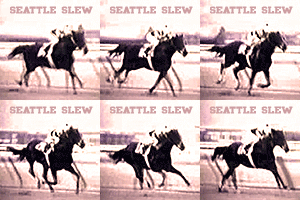
Then you see how Seattle Slew did when he got a sniff of those families!!!
(Double Baby League)
I tend to agree with the looking at the "whole" pedigree instead of one particular branch.
All the lines(male and female)are relevant IMO.
-
vineyridge
- Grade III Winner
- Posts: 1195
- Joined: Fri Jan 28, 2005 9:41 am
I just looked at Seattle Slew, his offspring and their winnings. One thing you almost have to say, given the number of mares in family 16 and branches that were bred to him, is that he seems to have been an anti-nick with mares from the Agnes families.
Heck, before long we'll be using MtDNA haplotypes instead of female families.
Heck, before long we'll be using MtDNA haplotypes instead of female families.
Thread Killer Extraordinaire
merse wrote:BUt back to the interior of a pedigree --
. . . John Sparkman recently had an article in the Thoroughbred Times where he listed the results of various sires for various stages of racing and distances. I think the list gives some good info but I haven't figured out how I'm going to use it yet.
How'd I miss that article? Do you remember which magazine [as in which date] it was in?
And pokeyman & louis - I always look at the sireline nick . . . after I've already made the breeding decision & am looking for a marketing tool. I'm perfectly comfortable breeding a "C" based on family ties - but if mama's family likes the guy & there's ALSO a good nick rating, so much the better.
But I have had several stallion managers try to persuade me to breed one mare or another on a nick rating. So I'm pretty sure it is mostly marketing on their end, too . . .
-
Bill from WA
- Breeder's Cup Contender
- Posts: 1936
- Joined: Thu Sep 16, 2004 11:20 am
- Location: Mountlake Terrace, WA
Another method of pedigree examination.
Bill
PEDIGREE APPRAISAL (VIA SEGMENT ANALYSIS)
A toy that was popular when I was a child was the kaleidoscope. I spent hours peering through the aperture, marveling at the seemingly endless patterns the pieces of colored glass presented. The gene pool of the thoroughbred horse might be likened to the pieces of glass in a kaleidoscope. Both contain a set number of pieces (genes in the horse as opposed to glass in a kaleidoscope) that when blended present a complete picture, or as in the case of a horse, a living breathing entity. The thoroughbred is in reality an inbred hybrid with a limited gene pool, and all that breeders have been doing for the past 300 years is mixing and remixing the same ingredients.
What I have endeavored to do with the creation of the “Modern Conduit Mare” application is to evaluate, and perhaps manipulate that gene pool in order to positively adjust the chances of breeding a better than average individual for the breeder who uses this method of analysis.
SEGMENT EVALUATION
There are 16 Modern Conduit Mare focal points in a 4-generation pedigree that are divided into segments for comparative analysis. The segment evaluation examines how the particular parts of the pedigree interact with each other, both through the target individuals and their respective Conduit Mares. This gives the examiner an idea of what and where crosses of individuals occur, and how these crosses may impact the overall pedigree. The Modern Conduit Mare interaction of these same individuals further indicates how the foundation, or bones so to speak, of the pedigree, influence the overall picture.
Using a 4 generation pedigree of Seattle Slew as an example, the method of approach to accomplish the segment analysis is to hypo mate positions 3 and 4 (and their respective conduit mares), Boldnesian & Poker (Reine de Naples/Doxa) then positions 5 and 7 (and their conduit mares), Bold Ruler & Round Table (Cloak/Altoviscar), position 6 and 8 (and their conduit mares), Hail to Reason & Jet Action (Trefle/Doxa), positions 9 and 13 (and their conduit mares), Nasrullah & Princequillo (Americus Girl/Mindful), positions 10 and 14 (and their conduit mares), Polynesian & Nasrullah (Fouilleopo/Americus Girl), positions 11 and 15 (and their conduit mares), Turn-To & Jet Pilot (Marchetta/Doxa), and positions 12 and 14 (and their conduit mares) Wait a Bit & Alsab (Niaxus/Eulogy). This process allows the researcher to evaluate how these hypo matings interact by examining the various crosses and how the genetic influences might be condensed and passed forward.
There are many instances when a pedigree that appears to be an outcross at first glance is really quite inbred when this method of evaluation is used. An examination of this broader picture of how a pedigree is constructed may offer clues as to what direction one may choose when planning a mating. The segment analysis may also offer a thumbnail sketch of the aptitudinal ranges via a triad breakdown of individuals within the segments who were foaled after circa 1965.
INBREEDING
Another aspect of segment examination is to evaluate horses that are inbred to two different individuals. An example might be where the sire is inbred to Northern Dancer 4x4, and the dam is inbred to Mr. Prospector 3x5. A hypo mating between Northern Dancer and Mr. Prospector shows what affinities these two sires share, and a look at a hypo mating between their conduit mares, Dazzling and Frizette, gives an indication of how this collaboration is formed from a root level.
The hypo mating of Northern Dancer and Mr. Prospector shows a male/female cross of Native Dancer 3x3, a cross of Nearco 3x5, Blenheim II 5x6, and Mumtaz Mahal 6x6 through the half sisters Mah Mahal and Mumtaz Begum, while the conduit mare match indicates crosses of Hermit (m/f), Newminster, Lexington, and Voltigeur. This collaboration indicates a concentration of genetic influences, which may show a tighter breeding pattern than might be apparent at first glance, even if the original hypo mating seems to be an outcross. It pays to look deep.
The Index, which is based on the statistical analysis of years of accumulated data, will not be absolute. As in any application dealing with living animals that rely on the care, treatment, and the training regimens established by human beings, there will be variances.
It must be noted, once again, that the designations assigned to the Conduit mares have nothing to do with the production history of any individuals, such as Northern Dancer, Seattle Slew, etc, but only reflect the aptitudinal tendencies of the high-class runners descending via the female family through the conduit mare.
Bill
PEDIGREE APPRAISAL (VIA SEGMENT ANALYSIS)
A toy that was popular when I was a child was the kaleidoscope. I spent hours peering through the aperture, marveling at the seemingly endless patterns the pieces of colored glass presented. The gene pool of the thoroughbred horse might be likened to the pieces of glass in a kaleidoscope. Both contain a set number of pieces (genes in the horse as opposed to glass in a kaleidoscope) that when blended present a complete picture, or as in the case of a horse, a living breathing entity. The thoroughbred is in reality an inbred hybrid with a limited gene pool, and all that breeders have been doing for the past 300 years is mixing and remixing the same ingredients.
What I have endeavored to do with the creation of the “Modern Conduit Mare” application is to evaluate, and perhaps manipulate that gene pool in order to positively adjust the chances of breeding a better than average individual for the breeder who uses this method of analysis.
SEGMENT EVALUATION
There are 16 Modern Conduit Mare focal points in a 4-generation pedigree that are divided into segments for comparative analysis. The segment evaluation examines how the particular parts of the pedigree interact with each other, both through the target individuals and their respective Conduit Mares. This gives the examiner an idea of what and where crosses of individuals occur, and how these crosses may impact the overall pedigree. The Modern Conduit Mare interaction of these same individuals further indicates how the foundation, or bones so to speak, of the pedigree, influence the overall picture.
Using a 4 generation pedigree of Seattle Slew as an example, the method of approach to accomplish the segment analysis is to hypo mate positions 3 and 4 (and their respective conduit mares), Boldnesian & Poker (Reine de Naples/Doxa) then positions 5 and 7 (and their conduit mares), Bold Ruler & Round Table (Cloak/Altoviscar), position 6 and 8 (and their conduit mares), Hail to Reason & Jet Action (Trefle/Doxa), positions 9 and 13 (and their conduit mares), Nasrullah & Princequillo (Americus Girl/Mindful), positions 10 and 14 (and their conduit mares), Polynesian & Nasrullah (Fouilleopo/Americus Girl), positions 11 and 15 (and their conduit mares), Turn-To & Jet Pilot (Marchetta/Doxa), and positions 12 and 14 (and their conduit mares) Wait a Bit & Alsab (Niaxus/Eulogy). This process allows the researcher to evaluate how these hypo matings interact by examining the various crosses and how the genetic influences might be condensed and passed forward.
There are many instances when a pedigree that appears to be an outcross at first glance is really quite inbred when this method of evaluation is used. An examination of this broader picture of how a pedigree is constructed may offer clues as to what direction one may choose when planning a mating. The segment analysis may also offer a thumbnail sketch of the aptitudinal ranges via a triad breakdown of individuals within the segments who were foaled after circa 1965.
INBREEDING
Another aspect of segment examination is to evaluate horses that are inbred to two different individuals. An example might be where the sire is inbred to Northern Dancer 4x4, and the dam is inbred to Mr. Prospector 3x5. A hypo mating between Northern Dancer and Mr. Prospector shows what affinities these two sires share, and a look at a hypo mating between their conduit mares, Dazzling and Frizette, gives an indication of how this collaboration is formed from a root level.
The hypo mating of Northern Dancer and Mr. Prospector shows a male/female cross of Native Dancer 3x3, a cross of Nearco 3x5, Blenheim II 5x6, and Mumtaz Mahal 6x6 through the half sisters Mah Mahal and Mumtaz Begum, while the conduit mare match indicates crosses of Hermit (m/f), Newminster, Lexington, and Voltigeur. This collaboration indicates a concentration of genetic influences, which may show a tighter breeding pattern than might be apparent at first glance, even if the original hypo mating seems to be an outcross. It pays to look deep.
The Index, which is based on the statistical analysis of years of accumulated data, will not be absolute. As in any application dealing with living animals that rely on the care, treatment, and the training regimens established by human beings, there will be variances.
It must be noted, once again, that the designations assigned to the Conduit mares have nothing to do with the production history of any individuals, such as Northern Dancer, Seattle Slew, etc, but only reflect the aptitudinal tendencies of the high-class runners descending via the female family through the conduit mare.
Hold fast to dreams, for if dreams die, life is like a broken winged bird that cannot fly.
Langston Hughes
Langston Hughes
Bill's method and theories are laid out in his book which you can get from his website. He has a workbook which, if you go through it, gives an insight into a pedigree that I haven't found elsewhere. It wasn't easy for me to follow at first, but he was quick with answers when I emailed him. I thought it was a terrific program, and I'd like to see a computer program laid out with similar results.
Maybe Bill can hook up with a computer guru and get a software program started. His workbook and book are very helpful but my little breeding program is on a small scale. I use the computer all the time for all sorts of other pedigree research, and a program like Bill's on the computer would be great. PQ uses his research and #'s, but it is not anywhere near the in-depth analysis that you get when you crunch the numbers for a particular hypomating and use his workbook.
Maybe Bill can hook up with a computer guru and get a software program started. His workbook and book are very helpful but my little breeding program is on a small scale. I use the computer all the time for all sorts of other pedigree research, and a program like Bill's on the computer would be great. PQ uses his research and #'s, but it is not anywhere near the in-depth analysis that you get when you crunch the numbers for a particular hypomating and use his workbook.

Re: New Nick method
pokeyman wrote:I was thinking.....if sire lines are the most genetically irrelevant (science has proven that this is so) than why not base nicks on female families (mitrochondrial DNA)? It would be pretty easy to do to see if, for example, 8-C nicks with 14-C. This seems to be a better method.
Your thoughts.........
Hi pokeyman,
Here are \:
Phalaris...............10-2-9-9-9
Sickle..................11-6-6-9-8
Pharos.................7-11-8-7-5
Pharamond...........6-2-4-9-8
Dosage profiles...................
Happy New Year,

Siegy,
Flora is beginning of biology, chemistry is master.